They Can’t Stop Us From Helping Each Other

It is never too early to start building the community you want to live in.

Recently I’ve seen some folks posting online about how, at this point in Trump’s last presidency, protests were filling the streets. How that isn’t happening this time around, and despair that there isn’t a more concerted effort to resist his destruction of the myriad institutions that make this country what it is.

I get how that can be despairing. Have people given up? Have we been defeated that easily?

I don’t think so. I think, what is apparent to so many of us whether we’ve put words to it or not, is that it is time for a paradigm shift. The way that well meaning people did politics in America doesn’t work, and hasn’t been working for years. I think that we’ve been clinging to old, ineffective strategies and tactics. I think our clinging to them is why Trump got elected the first time in 2016, and why he got re-elected in November.

I also think I know the work that it’s going to take to not only win out in this moment, but to ultimately inoculate America against fascist politics in the future.

But the ideas I have are not easy. A marketing campaign will not work. A pivot will not work. No set of focus groups is going to give us the answers we are looking for. Turning around this ship is going to take years. It’s going to take years because it’s years of work that, I think, a functioning society should have been doing the whole time. But we haven’t been doing it. Not only have we been letting our literal infrastructure decay and rot in this country, but we have been letting our civic infrastructure decay and rot as well. We’re starting at a deficit.

Something we can all do is build community. Find people who are like minded to you, and get to know them. Find the people who are present in your community, and get to know them too. Find the people who are different from you, and get to know them also. Get to know the decision makers, get to know the people who receive the effects of decisions. It is never too early to start building the community you want to live in. Don’t think on a large scale, think on the scale of your neighborhood, your town, your city, your county. It might seem like it will take forever to build community in every town, city and region in the country. Yes, it will, if only a few of us are doing it. But the more you build community with the people around you, the more community will expand through all the networks that naturally connect us. My one caveat here, however, is that we must build community in person. Online is great for marginalized groups. But the groups that feed us, shelter us, care for us, the groups that we work for and with – they can never be marginalized. Other than that I’m not going to tell you how to do it. I think the power actually lies in different people solving this problem in their own way. But I am sure that the more all of us feel connected to the communities around us, the more secure we are going to feel as the news from Washington DC gets scarier – and the better positioned we are going to be to defend ourselves and those we care about from what is to come.

This next idea is specifically for the politically connected: unite the country. I imagine that sounds painfully simple to the point of uselessness. The good things in life generally are simple. Having just read this explanation of how George Soros became a political boogey-man, it became clear that the politics of division were not successful immediately. They were something that was honed, tried, and experimented on over and over again. Folks who sought to divide us tried countless ways to do so, and simply stumbled upon the ways that worked. After trying for decades, of course they have now found a relatively reliable strategy. It is time for us to make that investment in uniting ourselves and inoculating ourselves against this division. We don’t necessarily know what is going to unite the people of our country together, that should not scare us away from taking on the task. Instead, lets us try all the things that we think could work. Let’s see what produces results, and then iterate from that. You might be thinking that we don’t have time for an iterative process… I would say we’re here now because we never took the time for an iterative process. If we don’t take that time, we’re never going to have the country we want.

I do believe that our country will be better at the end of this. If we want to take a long view of the challenges that face us, I would say that we face these challenges because we have not yet figured out how to prevent them. At all times in human history, people have been confronted by things that they could have prevented if they had known different. And people muddled through until they found the answers they needed. We will keep being confronted with this challenge, in different forms, until we learn to prevent it from happening. World War II, as awful as it was, was not enough for us to learn the lessons we needed to keep this from happening again.

I may have an even more positive view than Chris Hayes does, above. I believe that we are very near to being primed to being the awakened giant that Isoroku Yamamoto (probably didn’t so eloquently) claim we were after the bombing of Pearl Harbor. I believe this because, in my years being a human, I have found that we come to be defined by the challenges that we take on. The lessons that we learn from overcoming adversity stick with us well after that adversity is gone, and are passed down over generations. We are about to, finally, take on the challenge of fascist politics in our own country. Something that has existed here since before our founding. An America that knows how to defeat fascist politics when it is in our neighborhoods, in our families, and in our homes… that will be an America that can do great things, again (groan!). That is a future that I want for my country, my community, and my family.

These are my two broad, simple, and challenging goals for the foreseeable future. Build community and unite the country. I invite you to take on these goals as well. Let us see what millions of us can do when we take on this challenge together.
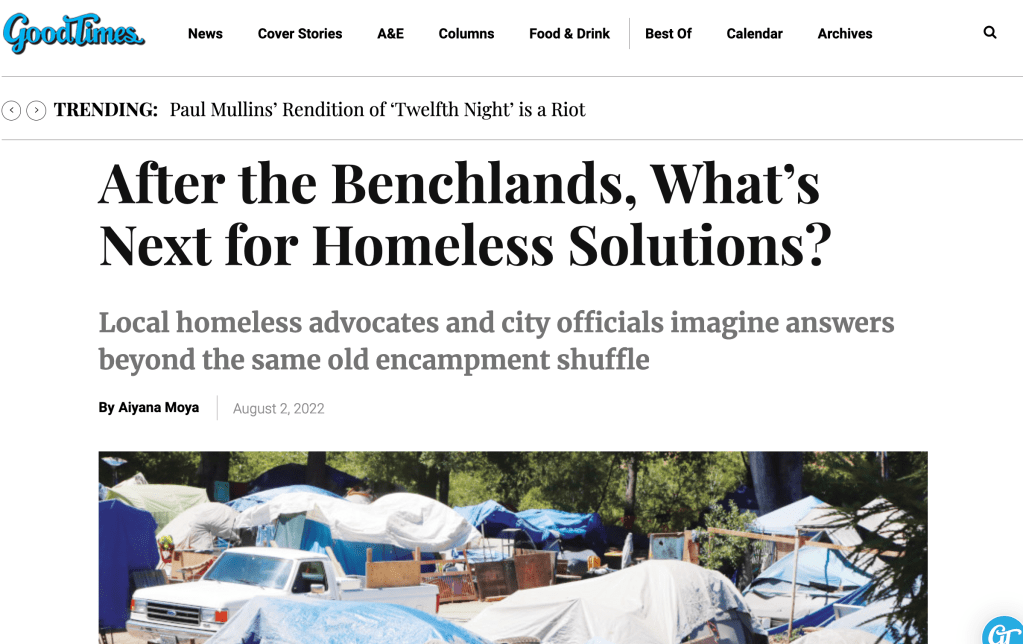
In the Press; What’s next for our homeless population after an encampment is closed?

let’s create a plan

I’ve been relatively quiet on this blog recently. But since I’m being quoted in local press, I figure now is the time to share a little bit. In Santa Cruz County, it’s time to start shifting the conversation around homeless from complaining about it and reporting on the facts of it to talking about what it’ll take to actually end homelessness here.

In this article, that’s part of what I’m laying out in my quotes.

a photo of the Good Times article. Because I felt like putting a caption here

Yet, what it’s going to take to end homelessness here (or anywhere in this country) remains elusive. Even though I could be considered an expert on the topic, all I have to offer are educated guesses myself. What we need, at least in Santa Cruz County, is more refined data. With refined data, we can evaluate what sorts of programs are successful and make sure that we have programs to meet the needs of each person experiencing homelessness. To their credit, the county is coming up with a way to get more refined data on our homeless residents. With decent data, I think we can start to develop a plan to end homelessness here. If we have a plan, then we can evaluate each action that the community takes through the lens of that plan. Without a plan, we end up with what we already have: What seems to be (to someone who is outside of the decision making process) an unrelated series of decisions and events that may or may not lead to anything. Without a plan, we end up going from urgent issue to urgent issue, without necessarily thinking in the sort of long term way that’s needed to actually make a notable dent in this years long issue.

But data is also more than just data points. In order to have good policy, we need our people who are crafting policy to understand the problem outside of the raw data points itself. That’s why one of my organization’s goals is to provide education; about what it’s like to be homeless, what it’s like to be a service provider, and what challenges we all are facing as we grapple with this issue. We aim to provide this education to everyone, because every single one of us are in a position to influence policy.

You’re going to see some of that here on this blog, but if you want to be sure to see it more regularly you should connect with my org, The Free Guide, on social media. We are only at the stage where we have launched our socials, we have not mastered the art of social media at all. But as we get better at them, you’ll get a bunch more good content from us on this stuff:

Instagram: @thefreeguide

Twitter: @the_freeguide

Facebook: Santa Cruz Free Guide

Email: santacruzfreeguide@gmail.com or contact@thefreeguide.org

If you are a member of the media and reading this, I’m interested in any project that can help the general public understand the realities of homelessness. I think it is truly going to take community wide action to address this issue. So, fire away with any questions or assistance you may need.

Here’s what helped me understand Israel & Palestine

If you’re like me, you learned almost nothing about the ongoing conflict in school

Growing up in the United States in the 80’s and 90’s, everything around me was pro-Israel… without any real explanation of how or why. Nothing truly opened my eyes to the history of the region until I stumbled upon the incredible podcast series by MartyrMade: Fear & Loathing in the New Jerusalem.

Darryl Cooper does a great job of telling the history as well as dispelling many of the myths we’ve been hearing for years.

For those of you unaccustomed to history podcasts, spending hours listening to something like this can seem daunting. MartyrMade is one of the very best out there, and the time goes by fast. History podcasts are my jam, I listen to them while I’m commuting.

How I Made Facebook More Tolerable

Since I haven’t deleted my account yet…

Let’s be honest, Facebook sucks. Those of us who are on there, are there because it meets some sort of utility for us. But the blatant – uncritical – sharing of propaganda by friends and family, the clickbait, the ads, the profiting from hosting disinformation and hate, the extreme disincentives to having constructive discussion on the platform… not to mention the stupid algorithm. THE ALGORITHM! It’s just all so much.

But the ability to connect with folks I care about on their platform is still unrivaled amongst social networks, and that’s why I haven’t deleted my account already.

So, what I did do, is unfollowed everyone who posts something once a day. Specifically, posting something that they didn’t create, on a once a day average. It has totally changed my experience of my facebook feed. I’m no longer bombarded by… crap. I unfollowed people whose politics I agree with, and whose politics I disagree with.

There are still political posts, there are still memes – but it’s thoughtful stuff now. I see the people’s posts that have some thought in them, and where they share about their lives. Because the facebook algorithm prioritizes what you interact with, and I will talk politics with anyone, all I was seeing before I made this change was rage and division inducing headlines. I didn’t unfriend anyone, I just removed some folks from my feed.

If you’re out there posting a bunch of stuff you wrote, photos you took, etc… I still see all that! I’m here for that stuff.

The Second Wave of Coronavirus is Already Here

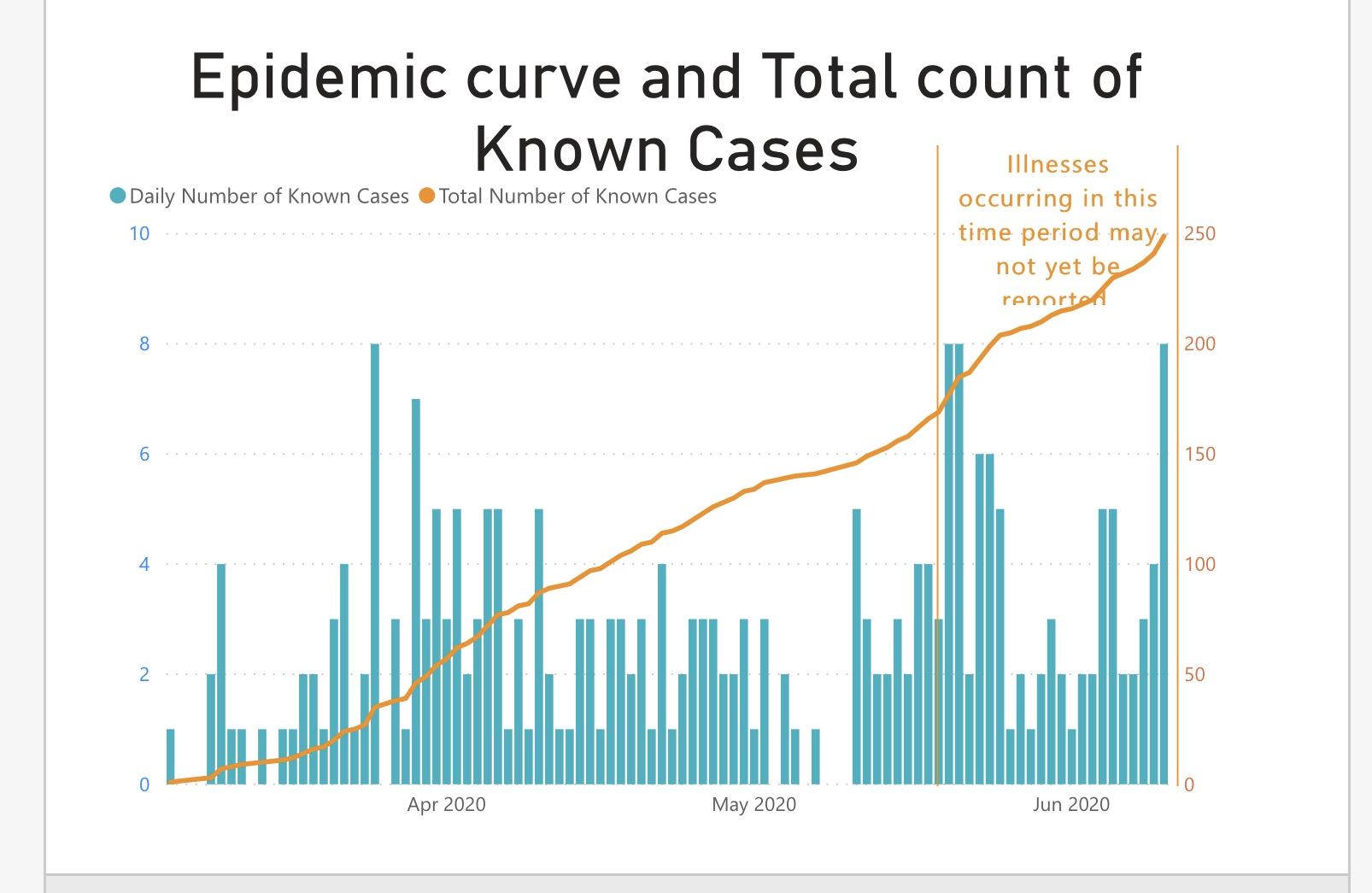
I’m very frustrated looking at the data on what is going on with COVID-19 in the US. I’m frustrated because this virus spreads when people are circulating together, and we’re opening up and having more people circulate together. My home county of Santa Cruz hasn’t even finished opening up, and it is already experiencing it’s second wave.

0281AB6B-4845-4582-8035-C334D9642E18

The source of that graph is here. I know Santa Cruz has relatively low numbers, it is the smallest county in California – however this info is unmistakable at this point.

The data for California (found here) is even more amazing – in the sense that there does not appear to even be a peak in cases yet. It is absolutely not the time to be easing shelter at home restrictions if we want to beat this virus. The headline I wrote for this blog is accurate for Santa Cruz County, statewide the first wave isn’t even over yet.

F1360067-E3A6-40DD-82B3-518A0EB66CF8

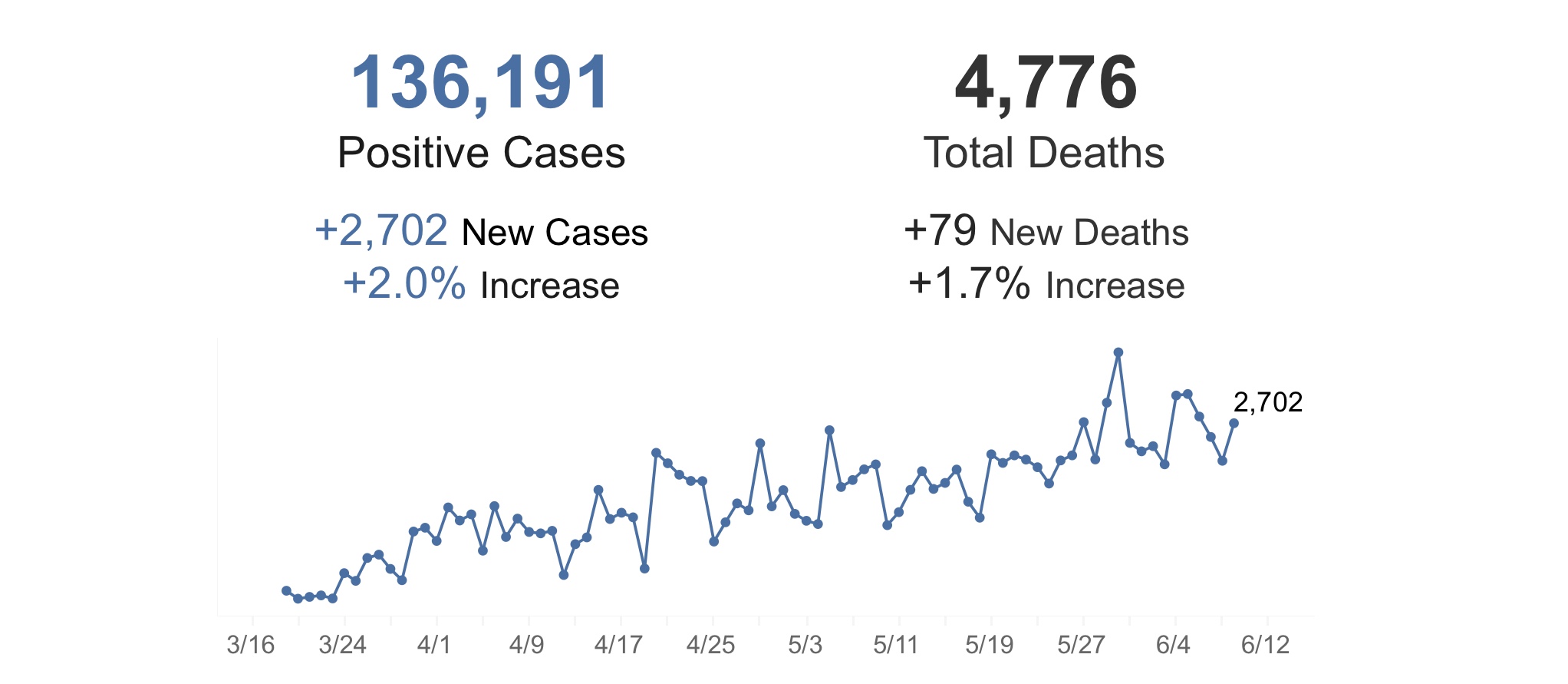
Nationally, the next week or so will tell us a lot. Will the recent rise in total new cases continue, or will the slightly falling overall trend keep up? With the amount of people protesting and generally circulating again, I’m guessing it will go up. But the next week, and possibly the week after that, will tell us if that guess is correct. Here is the data from the CDC:

4C4BC4F6-BBCE-42BE-A453-1F232ED1EFCE

Looking at national numbers isn’t terribly useful for fighting this disease, at least not in a country as large and diverse in population density as ours. But national numbers do tell us an overall trend. What’s alarming is that we’re nowhere near staunching the tide of new people getting this disease, yet we’re opening up as if we are. I’m planning accordingly, I hope you all are as well.

Maybe It Takes Getting to Know One Another

“People aren’t being seen”

For a long time now I have been pointing out to anyone who will listen that community is broken in this country. At least where I live, in California. I think we are seeing the consequences of that brokenness all around us; in our crazy political environment, our high homeless population, the ridiculous numbers of people in prisons and jails, even in the wide wealth disparity. Our rising suicide rate, our daily mass shootings, the mind-boggling amounts of money we spend on health care – the list of symptoms of our broken community just seem to go on and on. Oh, our lowering life expectancy too.

Since I work with people who are homeless, I do a lot of reading specific to the field. Street Roots published an article about the cognitive reasons why housed people struggle to feel empathy for people who are homeless. Not only is the article relevant to homelessness, I think it’s relevant to every aspect of our civic culture today. The italicized portions below are from that article.

“People aren’t being seen,” (Harris) said. “If I’m a busy person, going through a city where there are tons of homeless people, and I have to stop and consider the minds of all of these people, that might make me feel very uncomfortable. Moreover, if I don’t feel like I have the resources to help, there’s nothing I can do to alleviate that suffering. That feeling stays with you. Our brain says, instead, if I take a second to stop and think about your suffering, it’s going to make me feel bad. So, dehumanization becomes a kind of emotion regulation strategy.”

Online, with social media, we have all faced a time where we were forced to consider the mind of someone who clearly has wildly different views than we do. How much easier is it to tune those people out than is it to actually think about what they are saying? How much easier is it to, then, just write off people who share those views and de-friend them or block them out entirely? How hard is it to have your ideas challenged online and to refrain from yelling or letting the conversation devolve into insults?

“We readily help kids and cute animals, in part because we know that whatever trouble they’re in, they can’t really be held accountable,” (Zak) said. “We’re less likely to be so understanding and forgiving when it comes to homeless adults or drug addicts. This tendency to judge rather than help is partly the result of a spot in the prefrontal cortex called the subgenual cortex. It’s full of oxytocin receptors, and it appears to modulate the degree of empathy by regulating the release of dopamine. No dopamine means no reward from engaging with the other person, which makes it less likely that we’ll reach out empathically.”

In America, there seems to be a very strong desire to withhold services from people who don’t “deserve” them. This makes sense if, when we feel powerless, we dehumanize the people in our communities who need help. Since they are still suffering, they are living proof of our failures….

I’ve been wrestling with the idea that humans have an innate desire to help other humans. That commerce is based on contribution. What do people pay for? They pay to be contributed to. Whether it’s food, housing, entertainment, interaction. We pay for other people to contribute to us, and we want to contribute to other people. When we see people who are homeless, most of us see people we can’t contribute to. Most of us see that we have failed to help them.

Is it easier to blame the homeless than to take responsibility, as a community? I would guess that most of us don’t even think in terms of our community. We don’t think about what services we want to be sure that our community members have access to. We don’t think about what we as a community are doing to alleviate suffering in our midst. Is it easy to say “they made their choices,” “they are addicts,” “they are getting what they deserve?” Maybe the people who say those things felt the powerlessness of dealing with someone who’s choices were chaotic and out of control. Maybe they had to detach from a loved one to maintain their sanity and control over their own lives. A real community has each other’s backs. What’s it going to take to start thinking like that?

“If we design interventions to help people meet members of such stigmatized groups and get beyond the stereotype and see the person behind the social category, they tone down their judgments and feelings,” (Hewstone) said.

Hewstone is literally saying that if we get people from different social groups to meet and interact, then we will ratchet down the judgement, the yelling, and the divisiveness.

WHAT A THOUGHT

So then, if we had strong communities, maybe we wouldn’t be having this problem in the first place?

Now I’m going to talk about politics. I think that the level of division in our country is a security threat. It is a threat to our democracy. It appears that multiple foreign countries have figured out how to manipulate our elections and political process for their own gain. Almost exclusively, they are preying on our own divisions to do so.

Is it an incorrect conclusion then, that the best way to fight for and save our democracy is to get to know our neighbors? To meet and get to know people in our community who don’t think or live like us? To talk with the homeless, the middle class, and the rich? To talk with brown, black, white? To talk with young, middle-aged, and old? With men, women, and everyone in between?

That seems like a logical conclusion to me. It seems to me that it is time to do our patriotic duty. It seems like, all it’s going to take to stand up for the principles that our country are founded upon, is for you and I to go out and bridge the gaps in our own lives.

Bridge the gaps, instead of fighting for our point of view. No one is going to do it for us.

‘MERICA!

Let’s Take On Ending Homelessness in Santa Cruz

It can’t happen if we don’t talk about it

Join me, join us, to get this process started. For more info, you can email me here: evan (at) thefreeguide.org

Reuniting the US sounds like a Herculean task

How can I accept my country slowly, painfully tearing itself apart? A country who’s founding motto is “Out of Many, One.” A country that calls itself the United States.

A comedian friend of mine posted on facebook, that he wore a shirt that had some American flag themed decoration on it for his comedy set. That after his set, a lady came up to him and told him that he should not wear that shirt because he was obviously a liberal and liberals aren’t patriotic.

This is where we are at today.

We’ve been leading up to this for a long time. Way back in 2003, if my memory serves, I was working on a bond campaign for a local library. I was talking with a potential volunteer for the campaign, and he asked me if I was a Republican. I said no (I’m not registered with any party), and he said good – that he would never work with a Republican. But it was different then, than it is today. It wasn’t quite so… visceral.

I remember reading about a time when the political parties in this country could get along. Or at least, not view each other as the enemy. It seems to me that all that came crashing down when Newt Gingrich was the speaker of the house in the 1990’s. But the days of seeing allies across the aisle, if they ever existed, seem to be gone.

This is very upsetting for me. Because at some point, this state is a conscious choice for everyone involved. We choose to badmouth our political adversaries. We choose to lie about them. We choose to heap endless tons of criticism upon them. We choose to distort what we see to serve our political ends. We choose to tear down our fellow countrymen and countrywomen. We choose to shut out wide swaths of our own people from the political and policy making process. We chose this, and we choose it again every day. We are 327 million people (last I checked) choosing to do this to ourselves.

How does anyone turn that around?

I don’t know.

Maybe I have an idea, though. What I can do, is bring people together locally. Maybe that will make a difference. Maybe there are other people, in other parts of the country, who are doing the same.

Maybe getting people off of the internet, out from in front of their screens, and talking to each other – maybe that will make a difference. I feels, to me, that social media and media in general today is just designed to inflame. That we are all inflamed, and that’s why we don’t hear each other. That’s why people who think differently than us look like the enemy.

Normally, when I write about something that is bothering me, I write until I feel better. In this instance, I don’t know that I will be able to feel better about this. How can I accept my country slowly, painfully tearing itself apart? A country who’s founding motto is “Out of Many, One.” A country that calls itself the United States. A country where every man (and woman) is equal. The land of the free and the home of the brave. Maybe all that great stuff I was told about our country as a kid was hokum.

But that hokum is worth fighting for.

I don’t have easy answers here. Maybe all there is to do is to continue to move forward. To continue to try things, and to see what works. To continue to stand for what I believe our country should stand for.

Right now, that’s all I’ve got.

Liam Neeson is doing what we want

Chances are, you do something today that is not going to be socially acceptable in 40 years.

You are going to want to be able to apologize, show remorse, and move on. Lets give him space to do the same. He is not unrepentant, he isn’t saying “you know what? I’m still mad about this. I’m going to get my baton and go out into the streets of Ireland right now…” No. If he was, then go ahead, have at him.

He’s not a fragile man who thinks that you should never apologize. Liam is showing us how to grow. There are some people, who carry the same feelings he carried back when he went looking through Ireland for a black man to kill, who are only going to be open to changing their views when they see that someone else has already changed their views. Who, in the face of social pressure to change, are only going to harden their hearts and buckle down – but who will listen to someone who felt the way they do.

This is how we grow. If we don’t allow space for people to sincerely apologize and atone for their misdeeds, we don’t allow people to move on from the thinking that lead to those misdeeds in the first place. Something about our human brains; owing up to our mistakes allows us to let them go, hiding them doesn’t.

This is made somewhat simpler by the fact that he didn’t actually do anything. He didn’t assault or attempt to kill anyone, even though he meant to for a few moments of his life. This conversation gets more complicated when someone took an action that harmed someone else, but it’s still a conversation to have.

Also, what he wanted to do wasn’t okay then either. But it was significantly more socially acceptable then than it is today.

I, as well as most of you who read this, live in America. I admire a few of the people who founded our country in the late 1700’s, and consider most of them to be good people. Yet many of those men I admire were slave owners and probably misogynists.

Cultures and attitudes change, and in our time they are changing within our lifetimes. If we don’t allow people to raise their hand and say that they were wrong in how they thought, they are sorry and they have grown from thinking that way – then not only do we condemn them for the mistakes and foolishness of the past, but we condemn ourselves. For inevitably, one day we will find ourselves in their shoes.

Mourning 9/11, And Everything After

Now that I work with veterans, today was not an easy day

As I drove up to the 9/11 memorial this morning, I saw veterans outside greeting each other. I had to flee. I had to keep going. I couldn’t be in that space. I couldn’t be with men and women who had signed up to sacrifice it all – when I hadn’t. It felt… disrespectful. I felt as if I would be violating a sacred space.

All of my conflicted thoughts about 9/11 came to the surface at once. I found myself parked down the road, with tears in my eyes.

A vet asked me recently, why I didn’t serve. I told him that, being 18 on 9/11, I didn’t want to fight an insurgency…

He didn’t know what an insurgency was.

I’ve mentioned before in this blog how I had studied foreign affairs for years, and that I knew jihad was coming to the US – I also knew that our military and our society hadn’t learned the lessons from Vietnam. That we hadn’t come up with effective strategies for dealing with an enemy who could blend into the populace.

The mess that followed justified my decision. The expanded war in Afghanistan. The war in Iraq. ISIS… Dying via an IED on some street in Iraq would have been far from an acceptable death for me.

I also see 9/11 as a catalyst, a catalyst that exposed the fissures in American society. Besides the death and misery of millions in the Middle East; 9/11 brought us Obama, and 9/11 brought us Trump. The deep divide in our culture, the big oscillations between extremes – I see as responses to 9/11.

What there is for me is to mourn all of it. Not just the events of 9/11, but the seventeen years that have followed. The swift death of the America of my childhood (the 90’s)…

Yet, even though I feel as though I made the right choices for me, I have guilt. Guilt for not taking direct action in the face of a trying time. Guilt for seeing the options in front of me, saying “not the military,” and then not finding another way to take action. Guilt that I only feel on days like today.

So instead? I’ll do what I’m paid to do. I’ll go out into Santa Cruz county to look for homeless veterans. Just for the game of it, I’ll look for someone specific. I’ll see if I can find a young guy who was on the streets of Fallujah. Maybe in the back country of Afghanistan. I’ll go put the light at the end of somebody’s tunnel.

That’s how I can serve my country today. That’s what’s in front of me.

And the tears in my eyes as I finish this post are tears for 9/11, and everything after.


***Do you like this post, and my other posts? With the way social media works today, you’re most likely to see my future posts by subscribing to this blog. Just go up to the right, enter your email, and you’ll get notified whenever I post something. There’s no spam… no nothing besides an email in your inbox whenever I post something new. If you do get anything else, let me know and I set WordPress straight***