200 Might be a Magic Number for Representation

What’s next for democracy in America? Here’s one idea to improve it.

While we’re all watching democracy in America be stretched and strained these days… I’ve been thinking; What could make our democracy more representative of Americans? What could make it so regular, every day Americans actually feel connected to our government and our country as a whole? What could help us unlock the thousands, possibly millions, of capable and competent leaders in our country – so it doesn’t feel like we’re almost always having to choose between the least worst of two options?

Also, what can I do? What is the difference that I can make, on top of all of the other commitments that I have?

Me, while I’m writing this. Yes, it’s filtered 😛

I think, on top of all I’m doing as a dad with a full time job, I could effectively represent 200 people over the course of two years or so. That with lunch breaks and a few evenings and weekends, I could make sure that 200 people have someone they can go to to represent them in local matters. I can make sure that local elected officials have someone that connects them to their constituents – at least for the 200 people that I represent. Heck, I could probably act as a something of a hub connecting my local community.

I think that it may be time to experiment with Neighborhood Representatives. What if every 200 people in our country had someone who represented them to the rest of our government system? How empowered and emboldened, and connected, would we be? How motivated would you be to vote if at least one person on every ballot was someone that you know?

But wait, there’s more…

There’s something really cool about the number 200. That is, that it scales really beautifully. Say, for instance, that we implement some sort of Neighborhood Rep system and there is a representative for every 200 people. That representative acts as the liaison between every American and their city council member, county supervisor, school board, and maybe even water district.

There are 340,000,000 people in the US right now (according to Wikipedia). Divide that by 200, and you get 1,700,000. That’s a heck of a lot of Neighborhood Reps.

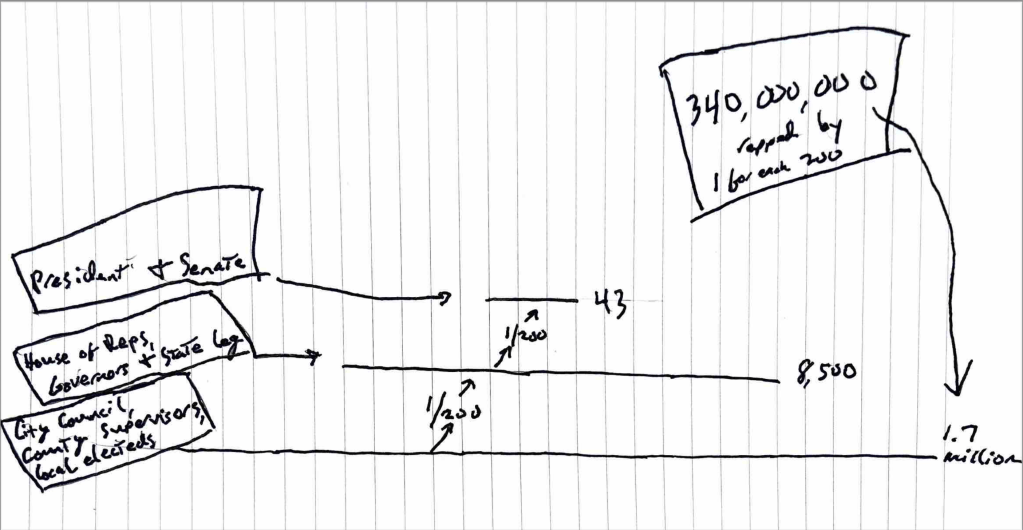
But if there’s a rep for every Neighborhood Rep? 1,700,000 divided by 200 is 8,500. 8,500 divided by 200 is 43. This means that, with three layers of representation, we could effectively make sure that every American is represented at the highest levels. That there could be only three degrees of separation between every single American and the highest levels of decision makers in our country.

Here, I hand drew a graphic so you can see what I mean:

Literally hand drawn. You’re welcome

If Neighborhood Reps connect everyone to their local elected officials, then the next layer up (the 8,500) could connect Americans (via their Neighborhood Reps) to their state officials. Here, I’m thinking the House of Representatives, Governors, and State Legislators.

If one representative is tasked with representing every 200 state-level reps, that gives us 43 at the federal level. I think these 43 would directly represent Americans to the Senate and the President.

How these representatives would interact with our elected lawmakers is difficult to define, but I think we all can see now that our lawmakers simply cannot effectively represent the massive amounts of people that are in their regions. My local county supervisor, the closest elected official that is supposed to represent me, has about 50,000 people in their region. The closest city to me has five city council members for a population of 68,000. That’s one person for every 13,600 people. Do you think you can represent fifty thousand people such that they all feel like their needs are heard and represented? What about thirteen thousand people?

No, I don’t think you can. I don’t think I can. I don’t think anyone can. I think in America we’ve forgotten that the government is us. It isn’t something that is separate from us. It’s not the people versus the government. The people are the government. I think a big reason we’ve forgotten this is that we’re so disconnected from the decision making in our government. I think it’s time to try things to change that.

They Can’t Stop Us From Helping Each Other

It is never too early to start building the community you want to live in.

Recently I’ve seen some folks posting online about how, at this point in Trump’s last presidency, protests were filling the streets. How that isn’t happening this time around, and despair that there isn’t a more concerted effort to resist his destruction of the myriad institutions that make this country what it is.

I get how that can be despairing. Have people given up? Have we been defeated that easily?

I don’t think so. I think, what is apparent to so many of us whether we’ve put words to it or not, is that it is time for a paradigm shift. The way that well meaning people did politics in America doesn’t work, and hasn’t been working for years. I think that we’ve been clinging to old, ineffective strategies and tactics. I think our clinging to them is why Trump got elected the first time in 2016, and why he got re-elected in November.

I also think I know the work that it’s going to take to not only win out in this moment, but to ultimately inoculate America against fascist politics in the future.

But the ideas I have are not easy. A marketing campaign will not work. A pivot will not work. No set of focus groups is going to give us the answers we are looking for. Turning around this ship is going to take years. It’s going to take years because it’s years of work that, I think, a functioning society should have been doing the whole time. But we haven’t been doing it. Not only have we been letting our literal infrastructure decay and rot in this country, but we have been letting our civic infrastructure decay and rot as well. We’re starting at a deficit.

Something we can all do is build community. Find people who are like minded to you, and get to know them. Find the people who are present in your community, and get to know them too. Find the people who are different from you, and get to know them also. Get to know the decision makers, get to know the people who receive the effects of decisions. It is never too early to start building the community you want to live in. Don’t think on a large scale, think on the scale of your neighborhood, your town, your city, your county. It might seem like it will take forever to build community in every town, city and region in the country. Yes, it will, if only a few of us are doing it. But the more you build community with the people around you, the more community will expand through all the networks that naturally connect us. My one caveat here, however, is that we must build community in person. Online is great for marginalized groups. But the groups that feed us, shelter us, care for us, the groups that we work for and with – they can never be marginalized. Other than that I’m not going to tell you how to do it. I think the power actually lies in different people solving this problem in their own way. But I am sure that the more all of us feel connected to the communities around us, the more secure we are going to feel as the news from Washington DC gets scarier – and the better positioned we are going to be to defend ourselves and those we care about from what is to come.

This next idea is specifically for the politically connected: unite the country. I imagine that sounds painfully simple to the point of uselessness. The good things in life generally are simple. Having just read this explanation of how George Soros became a political boogey-man, it became clear that the politics of division were not successful immediately. They were something that was honed, tried, and experimented on over and over again. Folks who sought to divide us tried countless ways to do so, and simply stumbled upon the ways that worked. After trying for decades, of course they have now found a relatively reliable strategy. It is time for us to make that investment in uniting ourselves and inoculating ourselves against this division. We don’t necessarily know what is going to unite the people of our country together, that should not scare us away from taking on the task. Instead, lets us try all the things that we think could work. Let’s see what produces results, and then iterate from that. You might be thinking that we don’t have time for an iterative process… I would say we’re here now because we never took the time for an iterative process. If we don’t take that time, we’re never going to have the country we want.

I do believe that our country will be better at the end of this. If we want to take a long view of the challenges that face us, I would say that we face these challenges because we have not yet figured out how to prevent them. At all times in human history, people have been confronted by things that they could have prevented if they had known different. And people muddled through until they found the answers they needed. We will keep being confronted with this challenge, in different forms, until we learn to prevent it from happening. World War II, as awful as it was, was not enough for us to learn the lessons we needed to keep this from happening again.

I may have an even more positive view than Chris Hayes does, above. I believe that we are very near to being primed to being the awakened giant that Isoroku Yamamoto (probably didn’t so eloquently) claim we were after the bombing of Pearl Harbor. I believe this because, in my years being a human, I have found that we come to be defined by the challenges that we take on. The lessons that we learn from overcoming adversity stick with us well after that adversity is gone, and are passed down over generations. We are about to, finally, take on the challenge of fascist politics in our own country. Something that has existed here since before our founding. An America that knows how to defeat fascist politics when it is in our neighborhoods, in our families, and in our homes… that will be an America that can do great things, again (groan!). That is a future that I want for my country, my community, and my family.

These are my two broad, simple, and challenging goals for the foreseeable future. Build community and unite the country. I invite you to take on these goals as well. Let us see what millions of us can do when we take on this challenge together.

Well, 2024, We’re Here Whether We Like it or Not

I’m coming into 2024 with a lot on my mind. We recently had to say goodbye to our good friend Joshua Coffy. My father in law passed away this year. Burning Man was a mess…

Professionally, someone recently told me that what my org is doing is “meteoric.” Since being nothing but an idea at this time in 2020, as of Tuesday we have nine full time staff, and handful of part-time staff, a budget over $1 million, and are about to move into our first real office space. Our initial program housed 45% of it’s participants in it’s first 14 months. And, there is so much more coming in 2024. The possibilities and opportunities on the horizon in 2024 are truly mind-boggling to me. I find myself looking into the future, seeing a bunch of question marks, and taking actions today to get answers to those questions. It is a challenge that I find myself relishing – even though it is often stressful.

The next thing for me is really cementing the way that we provide services throughout the organization. One thing, of many, that is going to distinguish us over time is delivering very effective services. To do that, we are going to have to codify what that means internally. I’m excited for that. A cool thing about our organization being about growth, healing and ending homelessness is that the growth and healing happens on our team as well. Yet, if we are about that internally as well as externally, how do we manage the logistics of that? This is a question I’m eager to answer.

Local politics will also determine the trajectory of what my org is doing. There are sales tax measures on both the city and county ballots that may directly fund our programs, if passed. There are also three elections at the county supervisor level that will change what decisions get made in our entire region.

My daughter (facebook link) continues to amaze me in her short time working in acting and modeling.

And yet, all bets are off if Trump wins in November. The relative stability that has marked our country since the Great Depression will be in danger, if not outright gone immediately. Professionally, I sometimes worry that I’m re-arranging deck chairs on a sinking Titanic. No one’s life will improve in the long term if Donald Trump serves another term, and that reality is going to present all of us with challenging decisions to make.

If you read me regularly, you know that Democracy is a prime value to me. I understand and sympathize with folks who feel like our system is broken. I agree that it is broken. But we cannot throw it out to replace it with a dictator. Those of us who criticized him in 2015 turned out to be right – please listen to us now as we continue to criticize him. He will dismantle the very thing that does actually make America great. I’m sure this list is just a start.

Anger, Fear & Democracy

Probably the angriest I’ve been in many years, was when I felt like I had to defend the integrity of my Burning Man camp. I’m not done apologizing to folks for how I did this (I truly was misguided) – yet I also found it instructive. If what pulls us to anger is defending what matters to us… then we all must be feeling like a lot of what matters to us has been under threat recently.

I certainly have. Every time I look at the news, there seems to be another threat to our democracy. There seems to be another threat to the rights, respect, and/or quality of life of average Americans. Even knowing that my news feeds have learned that anger keeps people engaged so they can show them more ads… is the news inventing these things for us to be angry about? I don’t think that’s exactly the case.

I’ve been thinking about how our history determines our future, in the sense of our politics. For me, the way to go about ending homelessness in my region is to bring together a wide array of people in the community and unite them around the common goal of ending homelessness. However, what I’m just wrapping my head around is that a lot of these people (even if I’m just meeting them for the first time) have bad blood already. They are nursing slights, hurts, upset and offense from previous attempts to make headway on homelessness in our region. So far I’ve been adept at getting these folks in the same room at the same time, but how do I help them to forgive each other? Or, at the very least, be open enough to working together again? How do I help these folks leave the hurt of yesterday behind, so that it doesn’t become the hurt of tomorrow as well?

Probably a lot of these folks felt like they had to defend what really mattered to them, from each other. Probably a lot of these folks felt like their ideals were under attack. I was in a conflict resolution training recently, and the trainer wrote that the Conflict Cycle starts with some sort of event, and then someone perceives negative intent behind that event. They act on that perception, and then people react to them. Then there is another event… and we are now in an ongoing cycle of conflict. Hence, the name. What struck me differently this time around was that someone has to perceive negative intent. I know that happens a lot in our community – people perceive negative intent pretty regularly.

One could argue that trait actually varies significantly across our political spectrum. That people on the right perceive negative intent from anyone who isn’t on the political right, and those on the political left perceive negative intent even from their own allies. Not sure how true this is, but a take to ponder further.

I think we need to stop thinking about Democracy as if we are done improving it. I fear that, in America, we’ve gotten so accustomed to revering the constitution and the founding fathers that we’ve forgotten that we can actually make our democracy better. And by better, I mean more effective at embodying the will of Americans.

An idea that I haven’t been able to get out of my mind is the idea of neighborhood representation. This is the idea that every neighborhood would elect someone to represent them to every elected official and government institution. The goal being that no one in America would be more than one degree of separation from someone who has the power to set policy and address their concerns about government. Of everyone reading this, how many of us have that experience now? I’m guessing it’s very few. Because of the nature of my work, I know quite a few elected folks in my region… and in my experience that is really rare. I don’t think it’s a coincidence that conspiracy theories and distrust of government is so high when so many of us are disconnected from the process and the outcomes of the process.

I also think we need to break up our two big parties. I have heard the “big tent” argument from Democrats, and I think we’ve all discovered that our current political climate would be much better if we had 4 to 6 viable political parties in this country instead of two. This would mean breaking down all of the institutional advantages that the Democrats and Republicans have, while making it real easy to start a new party and removing the barriers to running for office. It would probably mean completely undoing our primary system, and scrapping the electoral college. If we had an assortment of parties, we could avoid a situation in which extremists take over one of the two major ones. It is also much more difficult to paint anyone that isn’t in your party as wrong, evil, not a patriot, etc… especially if each party has to partner with others to get anything done.

These are just my ideas, but we need to have more. How else can we make the structure of our democracy more conducive to actual democracy? I think if we are unwilling to make our democracy more effective, we provide ammunition to the people in the world that argue that democracy is too chaotic. That the best governments are autocracies, dictatorships, or worse.

I do believe that it is a human right to have a say in how your government operates. I do also think that democracy has to be a lifestyle, a way of life. It is not sustainable to live our lives as little dictators who vote occasionally on who will dictate over us. I think that means working to achieve buy in, consensus, and agreement in all aspects of life. At work, at play, in our families, and in our communities. That means not forcing our desired policy outcomes on people.

That also means seeking out accountability. It is only the un-democratic who avoid accountability. If we seek out accountability, we are willing to own that we have messed up. We are willing to grow. If we avoid hearing that we are wrong or that we did something that is not okay… we are just going to continue doing those things, but in more sneaky ways.

We are also going to avoid holding our political leaders accountable when they do things that are wrong, because we don’t want to be held accountable ourselves. We become enablers.

The political discourse in America does feel like it can be broken down around accountability right now. The left seems to want to hold everyone accountable, the right seems to want to avoid accountability entirely – and to say “we’re not that bad, the left does the same bad stuff we do!” Of course, there are certainly people on the left side of the political spectrum who want to avoid accountability. It is an impulse we all must get over, after all.

A glaring weakness that is showing up for me recently is that I do not seem to have the patience to see where folks are coming from… or at least not as much as I used to. Whereas in the past I would be more understanding of people and their behavior, I am now much quicker to assume bad intentions. Or to just be angry with people. I do think that a big part of this for me has been Donald Trump. Being bombarded every day by clearly negative intentions from him and his allies makes it hard to have patience for anyone who resembles that sort of thinking. Covid added a layer of stress to that. So did the fires locally.

But another thing that I think robbed me of my patience has been starting a new homeless services agency. For me, that made every day high stakes. Will what I do today lead us to get a contract? Will I miss something that will endanger our financial stability? Am I working too slow? Am I too aggressive? Am I not aggressive enough? Will any of our program participants die? Will I assemble a team that works well together? How do I do everything while being a husband and a father, and having friends and a life? Did I miss something that is going to have catastrophic consequences? Will the people in the rest of my life be able to adjust to how different my life is? Will the powerful people in my community work with me or shut me out?

Will I get vilified by other service providers? Will I get vilified in the press? Will I get stabbed in the back (metaphorically)? Will I get stabbed in the front (metaphorically)? Will I be able to maintain any semblance of health while doing this? How much time with my family am I willing to miss? How much time with friends? Will I make a fool of myself? Will I let down my funders? Will I have to fire people I really care about? Will this adventure destroy relationships I have with people? Will I make myself unemployable and broke? Will my family leave me? Will I die early from the stress of doing all of this? Am I doing so much that something is going to inevitably come crashing down?

Am I going to be the focus of a targeted attack?

These are the worries that I haven’t been allowing space for on this journey so far. But there is a saying that I know to be true; what you resist persists. Being unwilling to air these fears out has meant that they have not gone away. Maybe writing them all now will start me on the process of re-balancing myself. Will I even remember what it feels like to have a strong emotional equilibrium?

Regardless, there are things that I have learned on this journey. The most valuable thing, I believe, is that I am as capable as I believed I was. I yet may be even more capable. Knowing that has changed my life irrevocably. Knowing that has caused me to consider what bigger differences I can make in this world. Given all the stress, frustration and fear… I find myself saying “What else can I do?”

No, You Don’t Fire the Google Guy

I view this as a failure of management.

I have a rule when it comes to hiring, and that is to hire people that I can support. That means that I hire people that I can have open communication with and who can listen to constructive feedback from me – and who can give me feedback as well. I hire people that will tell me what is on their mind. Hand in hand with that, is that I make sure that I’m someone that people are generally comfortable sharing that kind of stuff with.

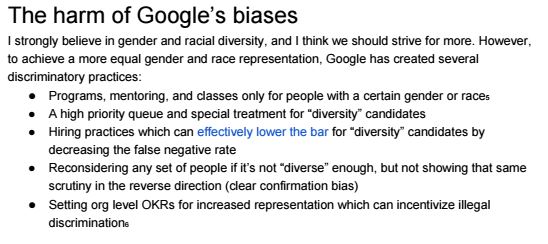
Then, if I’m doing my job correctly, I’m checking in with them regularly. So if one of my staff starts saying things like this about our company:

Google's biases.JPG

I can address their concerns, one at a time, before they get incorporated into some “manifesto” that then spreads like wildfire across my company. From my perspective, if I’ve gone to the trouble of hiring this person, I need to treat their concerns as valid even if I don’t agree with them. Maybe they need coaching, maybe they need mentoring (maybe I need to hook them up with a mentor), maybe they just need assistance thinking through the opinions they have. But I, as their manager, cannot be brushing off their concerns.

That being said, the concerns in the above image (that are directly from his manifesto) absolutely need to be addressed. In the effort to create an equality based workplace and society, we must keep in mind that not everyone feels like they have experienced the benefits of not being discriminated against. What matters to people the most, regardless of the justice or injustice in the rest of the world, is their own experience. If it is in fact true that there are “programs, mentoring, and classes only for people with a certain gender or race” – that absolutely needs to be rectified. It comes across as blatantly unfair. We don’t know what support any particular person has experienced throughout their lives. We cannot be assuming that any given white man doesn’t feel the need for these programs as well.

If I’m really doing my job, as a manager, coach, or mentor, I’m separating the concerns about policies and practice from ideological and political stances. That is definitely something that needs to be done with this guy. He quotes a lot of research and data that has been politicized in our crazily biased political world, and does a lot of theorizing about why Google is the way it is… All that stuff really is irrelevant. The questions that need to be addressed are all around “what policies and practices do you disagree with or want done differently?” Once you allow the conversation to get into theorizing about why things are the way they are, or grand theories about what principles the company should or shouldn’t emphasize instead of addressing individual practices, you get into areas where people are likely to be offended and alienated.

The ideas that he presents in his manifesto are not exclusive to him. They are, in fact, common in our society at large. That means that if you aren’t dealing with them when he brings them up, you are going to end up dealing with them when someone else brings them up. You can’t actually expect to have a workplace that has diversity of ideas if you marginalize people with these concerns, or fire them when they express them. They absolutely need to be addressed, and where appropriate, rectified.

Otherwise, you end up looking like this to a large portion of the population:

Google individual.jpg

I’m not saying this cartoon is accurate. I have no idea what it’s actually like at Google. But I can say, for certain, that this is what it looks like to a lot of people who are outside of Google looking in.

(Sorry, I have no idea who created that cartoon. I found it floating around the internet unsourced)

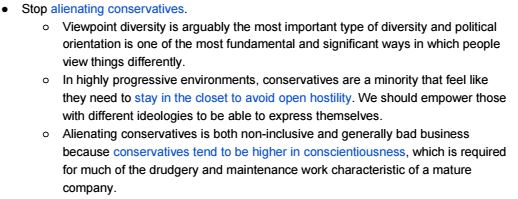
Another thing that needs to be addressed, is this. Again, directly from his “manifesto”:

Alienating Conservatives.JPG

Yes, conservative people do often feel like they need to stay in the closet in largely liberal groups. Look, I know that liberal people think that they are open-minded and non-judgemental – I used to think the same way. That is in direct conflict with the experience of many conservatives. This is part of why we are experiencing the division in our country that we are; people of a conservative viewpoint did not feel like their viewpoint was being addressed in the news, media, or entertainment of our culture at large. So they made their own. I’ll let you all deduce the consequences of that.

Obviously, if you’re going to empower those with different ideologies to be able to express themselves, you need to do it in a context where people aren’t purposely making each other angry, where they are being civil, and where they are being respectful. So essentially the opposite of what is going on in our popular society at large. Maybe you haven’t experienced that kind of environment, but it is certainly possible to do.

Most importantly, if you are in regular communication with your staff about their needs and can address this stuff as it comes up you can offer coaching and perspective that makes a difference. Lots of what this former Google manager said absolutely does need to be communicated to our manifesto writer. Things like this:

If you’re a professional, especially one working on systems that can use terms like “planet-scale” and “carrier-class” without the slightest exaggeration, then you’ll quickly find that the large bulk of your job is about coordinating and cooperating with other groups. It’s about making sure you’re all building one system, instead of twenty different ones; about making sure that dependencies and risks are managed, about designing the right modularity boundaries that make it easy to continue to innovate in the future, about preemptively managing the sorts of dangers that teams like SRE, Security, Privacy, and Abuse are the experts in catching before they turn your project into rubble.

Essentially, engineering is all about cooperation, collaboration, and empathy for both your colleagues and your customers. If someone told you that engineering was a field where you could get away with not dealing with people or feelings, then I’m very sorry to tell you that you have been lied to. Solitary work is something that only happens at the most junior levels, and even then it’s only possible because someone senior to you — most likely your manager — has been putting in long hours to build up the social structures in your group that let you focus on code.

I’m not saying that our manifesto writer is all-correct (absolutely not). I’m saying that in any managerial context you give someone an opportunity to correct their error-filled ways before you terminate them.

And, most importantly, there is nothing about the manifesto writer’s tone or writing that indicates that he is some sort of raging ideologue. He sounds to me like someone who can be reasoned with. He openly says that he wants a diverse workplace. He cites a lot of his points with data and studies. That is a great entry into getting him to rethink his viewpoints, by pointing out that how those studies are flawed – or pointing out how his thinking about them is. If, in fact, it is. Part of engaging with people who disagree with you, is that if you are going to do it honestly and effectively you have to be open to them teaching you something about the world as well. I know it can seem really important to fight for our viewpoints in the face of resistance, but it’s difficult if not impossible to listen while you are fighting.

Under every position is a concern or series of concerns. When I am a manager, I view it as a big part of my job to remove the concerns of my staff so that they can focus on doing their work.

Instead, what Google has done is reinforce those concerns by literally firing him for expressing them. This is not isolated to him or to Google either. Google has reinforced those concerns amongst the millions of people nationwide that have them. Now, they are stronger. To them, this is what happens when conservatives speak up in liberal environments. They lose their job.

Google has chosen a side in the culture wars, whether it wanted to or not.

Why do you think there is so much push back against PC culture? Because this stuff happens.

For reference, here is the “manifesto

Democracy Today

I’ve been thinking a lot about democracy recently. How, ideally it seems, what democracy allows in a society is the ability for a population to consent to their own governance. Which is really great. Like really great you guys, really this cannot be understated. The opposite of consenting to your own governance is oppression, manipulation, exploitation, disempowerment… and people generally having less say and control over their lives and the direction of their community than they want.

Image made by the very talented Josh Coffy. Check out his stuff here.

Democracy also requires people to engage in a certain level of civility. To really do democracy, you have to be willing to accept that the ideas and beliefs of other people are valid and need to be addressed – even if you think those ideas and beliefs are completely and totally wrong. Because otherwise, how can you work with them? Democracy, as is defined by google, is “a system of government by the whole population.” That means you have to work with the whole population, find common ground, and create agreement so that you can move forward in the best interest of your town, city, community, state and/or country.

I’ve been thinking about democracy a lot because everywhere I look in the news and world today I see either failures of democracy or people deliberately subverting democracy to achieve their political goals. There are a lot of reasons this is foolish, but I think the most important point is that when we erode democracy to reach our goals then our achievements are decidedly temporary. When you do not create consensus, or even agreement, what you get is instant resistance to your policies regardless of how good your policies are. It simply does not matter how right it is, the thing that you want to do. When you force that thing upon people they are going to focus on the negative aspects of it.

A textbook case is the most recent attempt by Mitch McConnell and the GOP to “repeal and replace” Obamacare. Whether you agree with that idea in principle or not, I can tell you with absolute certainty that writing the bill in secret, giving people an hour to read it, and then forcing a vote is not an effective way to create consensus. And what do you know? They couldn’t even get the 52 Senators in their own party to agree on the thing.

Another disparate example is the first post-Saddam Hussein government in Iraq. It seemed to be more interested in subjugating the Sunni parts of the Iraqi population than serving them… and then the Sunni militia Jama’at al-Tawhid wal-Jihad became Al-Qaeda in Iraq – which then became ISIS. Many more people have written much more in-depth than I will about ISIS, but making sure a significant portion of your country is not served by your government is a great way to destabilize your country.

“Those who make peaceful revolution impossible will make violent revolution inevitable” -JFK, according to the internet.

Whether or not JFK actually said that (I’m not going to believe stuff just because it’s been made into memes on the internet), I think that quote is the most prescient lens through which to look at events throughout the world today. Functioning and effective democracy is a means by which we allow for peaceful revolution, as well as peaceful change and peaceful growth. A judiciary based on the rule of law is another. When those institutions are subverted, we increase the likelihood of injustice. And when that injustice is not addressed, eventually people turn to violence.

Not that we should be waiting until people want to take up arms to secure the institutions of our democracy. I value consent, and a functioning democracy ensures that it’s citizens our governed by consent. Maybe not everyone values consent? I don’t know. But for me democracy is important because it is the best means we have to governing with consent. And we should always be working to make sure that whatever our government is has as much consent as possible.

That’s what I’m thinking about these days…

Also, if you like what you’re reading when you see my posts – scroll down and subscribe so you don’t miss any!

What My Platform Would Be, Were I To Run For Office Today

No, I’m not running for office today. But, I figure now that the US has elected Donald Trump as President, anything is possible. So might as well get prepared, right?

Image courtesy of inspirobot.me

First and foremost, I am calling a truce between Liberals and Conservatives. Not that I have the power to do that (ha!), but I personally am making peace with both. I am going to seek out data and perspectives from all sides of each issue. I am going to engage in civil discourse with whoever has a stake in the outcomes of the decisions I make in my position, even if their discourse with me is not civil. Our society, indeed every society, needs people of both liberal and conservative persuasion. I intend to include perspectives of all orientations in the governing process. I understand, as you are reading this, that you’re thinking “but _____________ don’t use real data and they manipulate the truth!” That’s exactly what they think of your side as well. Effective government needs to address the concerns of all sides, and to do that one must engage. I cannot and will not stand at a distance and say that they aren’t to be trusted. There are legitimate reasons that each side is so animated about their perspectives. Please also remember that when I say I will engage with all sides, that means that I will also engage with yours. I’m sure that my position of being neutral will attract attacks from both sides, we all know that neither side likes what is not their own. I am prepared for that. If one is unwilling to stick by principles when they become difficult and inconvenient, then there is no point in having principles at all.

Education: I think our education system is the most pressing concern in our country today. If you’re reading this and saying “No! It’s the economy!” My view is that the biggest factor in the state of our economy is our broken education system. We, as a country, need to be encouraging innovation in methods throughout our education system, and we need to develop a system to promote the most effective strategies and tactics nationwide. We also need to review what exactly we want to be teaching our children. Is our curriculum current? Is it even relevant? These questions we need answers to – and we need the average person on the street to be engaged in this process, not just educators. The entire country has a stake in our education system, and our entire country needs to understand what is going on inside of it and how it works. We need to look at the structure of the entire school day. We need to consider yearly internships, arranged by the school, starting in the first year of high school. We need a nationwide review of our education system, from the ground up. We should be including the feedback of teachers, students, parents, and community members. We need to commission rigorous tests (aka; scientific studies) of all the fundamental aspects of the school experience to determine their effectiveness. However we also need to trust the voices of educators. We can look to other country’s systems for inspiration. The old system of American education no longer works, it is time for us to do the work to craft a new system. Motivated actors (private schools, charter schools, etc), have their place, and they can be included as much as they participate. But our public schools must be the class of the world.

-Education Funding: Every public school in the US must be funded equally, with adjustments for population and cost of living. We must do everything to ensure that the quality of education one receives at schools in poor inner city neighborhoods and in remote tribal areas is equal to that of the best schools in the country.

-Education for Adults: Let’s be honest, 16-18 year olds in our country today are probably not in the best position to determine what profession or professions they will be working in for the rest of their lives. We need to modify our education system to remove the boundaries for adults with careers, including (and especially) grants and programs to fully support people who are transitioning out of failing companies and industries without totally decimating their life savings and completely disrupting their lives.

Economy: The engine of our economy is the middle class. It is no wonder that the majority of the country has not experienced much of a benefit from the so-called recovery from the 2008 crash: the middle class is assailed on all sides. We must combine policies and practices that protect the middle class and bolster their ability to continue to thrive financially. This includes strengthening and enforcing consumer protections, ensuring that everyone has access to affordable healthcare (even when starting their own business), reducing the cost of higher education, ensuring that the best interests of employees are being watched out for and protected (via unions or other mechanisms), making sure childcare is available and affordable, and ensuring a minimum level of financial literacy nationwide. This also includes testing ways to get people from low-paying jobs into good paying jobs, especially out of low paying jobs that still require people to be on government assistance to get by.

Democracy: We need to strengthen our commitment to democratic practices throughout the country and the world, even if it harms our short term interests. This means ending gerrymandering and registering every citizen to vote. This also means having polls be open 24 hours a day and/or voting day be a national holiday. If we are truly concerned about fake/illegal votes, we need to supply every citizen with a valid ID that proves that they can vote as soon as they are of age to do so – free of cost. We cannot be effectively disenfranchising people who are unable to overcome logistical hurdles to getting their vote counted. It is also time to detach our election process from dependence on two entrenched political parties.

Foreign Policy: Promoting democratic practices also means doing so worldwide. It means that we don’t prop up dictators to access a country’s resources in favor of democratic movements that may not let us use their resources. It means we don’t sell technology to undemocratic regimes that will help them repress their populations. It means favoring policy and strategy that ensures that all voices in a given country are heard, even if we don’t like all of those voices. This is what we must do if we are going to be true to the ideals that our country was founded upon. If we do not continue to honor our shared ideals, then our conflicting self interests will eventually tear us apart.

Iraq & Afghanistan: It’s time to embrace the possibility that to get out of these countries the right way, it could take as much as 40 years. It was certainly a mistake to go into Iraq, and I’m not sure of the wisdom of toppling the government in Afghanistan either. But to exit without either of them becoming despotic hellholes or descending into (more) civil war means that both countries need to have functioning democracies and established institutions. Both of those things take time, a lot of time, to truly put in place. I definitely want to get out of both places as soon as possible, but as soon as possible and responsible may be 40 years from now. That’s a big pill to swallow, we may as well start swallowing it now.

Environment: Well, we gotta talk about global warming if we’re going to talk about the environment. A lot of good scientists have concluded that our planet is warming up because of human activity. However, I’m not going to agree with, let alone advocate for, any legislation around global warming (or the environemnt in general) if I do not understand the science underpinning the legislation, if the science uses sample sizes that are too small, or the experiments have not been duplicated. I’m also going to make a point of understanding whatever critiques their are of the science. I understand that people who perform scientific experiments are prone to ego, bias, statistical & procedural errors and motivated reasoning. I also understand that their detractors are prone to the same things. We must make sure that our planet remains to be a place that we can all live. We must also understand that not protecting the environment can have terrible effects on economic concerns, just as environmental regulations can. We need to work to find a balance between the two in all circumstances.

Gun Control: To buy a gun, a person must be licensed. The licensing process needs to include extensive gun safety training. How to shoot safely, how to clean and maintain a weapon, when guns are appropriate to use and not, an understanding that in most circumstances guns escalate problems instead of resolving them, and safe gun storage. We must emphasize safety and responsibility with all licensed gun owners. Licensed gun owners must be mentally sound and not be violent criminals. I understand that the NRA argues that any gun regulation is a slippery slope to take away everyone’s guns. They are literally just fear-mongering because that is what they are paid to do by the gun industry. There is huge support for reasonable gun control, we need to change our gun legislation to match that support. Oh, and with all gun training we must address the fact that 60% of gun deaths in the US are suicides.

Healthcare: Quality healthcare needs to be accessible and affordable for every US citizen. I view Obamacare as the first step among many between the privatized healthcare/insurance system we used to have and a system that will eventually provide effective healthcare to our country.

Police: We need to set and enforce standards of policing nationwide. That includes ensuring that all police officers get enough support and time off so they do not get burned out and callous towards the people they serve. We must also provide extensive training to every police officer in the art of de-escalation – similar if not exactly the same as the training in the UK where the police do not carry guns. We need to end the war on drugs. Whatever laws are changed in the ending of the war on drugs also need to be retroactive, releasing people convicted of those crimes from prison. We need to end the practice of municipalities using their police forces as a source of revenue. We must also develop and improve the existing program(s) for reintegrating convicted criminals back into society, so that reintegration is relatively smooth and convicts are not released into the same sort of environments that led to their committing crimes in the first place. Police must also receive extensive training on the political, cultural, racial, and economic tensions within their area and how they affect their job as police. Police in our country must also be protectors of our right to freedom of speech – meaning that their only role during any protest is the prevention of direct violence. People who are staging protests must be able to view the police present as peace keepers, not antagonists. The burden is on police departments to modify their behavior to fit that goal.

Immigration: A big reason that the United States has thrived over the past hundred years or so is because we have successfully integrated large numbers of immigrants into our country and our culture at large. Immigration means a larger labor pool, but it also means a larger customer pool. Larger customer pools are good for business. This is a process that must continue. It’s time to create a streamlined worker visa program, one whose application is one page long and takes no more than a month to be reviewed, vetted, and completed. No years long wait lists, no having to come to this country illegally because you can’t wait for your application to be approved to feed your family. You submit your application to come here to work, you are approved or denied in one month, and as soon as you are approved you can enter the country. Once you are here for a few years, you can start the citizenship application process.

Refugees: First off, taking in refugees is a great PR move. Want an entire nation of people to have goodwill towards you? Take in their refugees when they are at war. Obviously we need a way to weed out actual militants, but the system we have in place in this country has already been very effective at that (certain parts of the media disagree… but in this case their ignoring the facts). Also, if we really want to learn how we need to be responding to the situations in these war torn countries, we need to be debreifing these refugees as they come to us. This is a huge source of intelligence that we are actually discouraging from coming here. Don’t expect the US to be terribly effective in these theaters until we make up for that intelligence gap.

Institutional Effectiveness: I have saved this one for last, because it has the most boring name. But it may be the second most important thing on this list behind education (well, third if you count the next entry). Every institution and agency that is organized under our government must be run well. That means staffed accordingly, having clear goals, and clearly knowing when they are meeting their goals or not. It means cutting wait times for the people who are serviced by these agencies, reducing paperwork, reducing red tape, and streamlining processes. It means making sure our employees are satisfied in their work and are compensated accordingly – because employees who consistently meet those two objectives consistently provide excellent customer service. The people who serve our country men and women must be providing good customer service. If we deem that it is too expensive to do what we do well, then maybe it is time to cut some services. But that is not a decision to be rushed into.

Oh, and we must negate the effect of big money on our elections. Easier said than done, I know. I’m open to ideas on this one.

This is a statement of priorities and principles, not how they are going to be acheived. Basically every politician makes promises, then get in office and discover that the realities that they are facing make their promises untenable. I’m not going to run that treadmill. I cannot say that I would attempt to make this all happen at once. These priorities do need to be balanced with fiscal needs and organizational needs wherever I serve.

I would love your feedback

Abortion Doesn’t Have to Divide Us

I think there is a foreseeable future in which the issue of abortion does not divide people and determine elections. That doesn’t mean I think that people are going to stop arguing about whether or not abortion should be legal. At least not in the US, not in my lifetime. But it does not need to continue to be the political football that it is.

What got me thinking about this was this piece on what it was like before abortion was legal in all 50 states. It was pretty harrowing to read what women who felt that they needed abortions had to go through before abortion was legal. Then, a friend of mine commented on it:

Friend: “I take responsibility for all I do. I break it I buy it. I don’t see a difference in having sex without condoms or other controls. Don’t play the game unless you can live with the outcome. Its still killing a child no matter how they want to paint it. When my wife said she was pregnant and asked what we should do I said..have a baby..I was out of work..she had a low paying job and we struggled..I sold things to make ends meet. We used WIC for a short time..but we didn’t kill our baby because it cramped our life style or it was the wrong time..bullshit excuses..grow up. Take responsibility for your actions and their outcomes.”

I responded: “I get wanting people to take responsibility for their actions, but I also think illegalizing abortion will take us back to the world described above…” (above being in the article)

A lot of people, like my friend, like to couch their view of abortion in the language of personal responsibility. But a child is more responsibility than one person can bear. As a father, I can tell you that having a child really is more responsibility than two people can bear without a lot of support. Every woman who is pregnant has to make a judgement call about whether or not the community around her will support her in raising her child. This isn’t something that the pregnant woman will necessarily have thought of before. I would hazard a guess that most people don’t think about it. At least in our culture, that seems to prize independence, I wonder how many people think about their wider community when they are considering having a baby. How should people even begin to think about that? But I’m getting off on a tangent…

My friend, and many other people, argue that if you can’t live with the consequences you shouldn’t do the deed. That’s fine as an argument, but we aren’t going to be illegalizing unprotected sex. Nor are we going to be making a law that says someone can only have unprotected sex if they want to have a kid. People are well within their rights to have unprotected sex if they choose to. So sure, you can tell people that they shouldn’t have unprotected sex if they aren’t ready to have a kid – but saying that isn’t going to stop anyone from having sex, nor is it a substitute for policy. Ultimately I’m not sure what good it does to even make that argument.

I suspected that the reason most women have an abortion is because the logistics aren’t lining up for them. So I googled, and literally the first relevant response backed up my suspicion. 86% of respondents in the most recent study I found cited reasons for getting their abortion that I would categorize as logistical: unready, can’t afford baby now, has all the children she wanted or all children are grown, has problems with relationship or wants to avoid single parenthood, is too immature or young to have a child, would interfere with education plans/would interfere with career plans.

This makes me think that we’ve been focusing on what divides us instead of what can unite us. Sure, whether or not abortion should be legal is a thing that divides our population. But making sure that pregnant women have the support they need to confidently give birth is a completely different conversation that does not have to divide us. That is simply a question of logistics. What logistics would make a difference for people who would, in today’s world, consider abortion? Enough maternity and paternity leave, robust adoption and foster programs, affordable day care and affordable medical coverage – I’m just brainstorming here, but these are what come to mind. I imagine that those of you reading this can come up with more good ideas as well.

If it is indeed roughly accurate that 86% of abortions in the US in a given year are due to pregnant women not feeling like they can get the support they will need (don’t take my word for it, I just did a cursory review of one study)… then we’ve been having the wrong conversation this whole time. The primary question is not “should abortion be legal?” but “how do we support women who are pregnant?”

Whether or not abortion is legal isn’t going to change the demand for abortion. But I do think we have to consider the role of government policy and/or private institutions in a woman’s calculus when she is choosing to have a baby or not. I think that if we address this as a society, we can look towards a future when the issue of abortion is actually in the rearview mirror. When we can read about it in history class, instead of in blaring headlines in the news feed of our choice.

New Podcast: Topics

Check out my new podcast: Topics

Our political climate makes it very easy to not hear views that differ from our own and to ignore the humanity of people who don’t share our point of view. Topics brings people together to talk about issues that matter, in a forum where they aren’t going to be judged or belittled for having their point of view. We also interact with ideas, in a way that encourages everyone to re-think how they view things.

Our Views Have Been Weaponized. Or, What We Don’t Talk About When We Talk About Immigration

In America we don’t actually talk about immigration, really. We talk about loosening immigration or tightening it. We talk about where immigrants should or shouldn’t be from. Or what kind of people they should or shouldn’t be. A conversation about immigration would be much different than the conversation we are having.

If we were going to have a real conversation about immigration we would start by answering the question of; how many immigrants do we want at once? What is the ideal mix of new and old residents that preserves the original culture while being enriched by the culture of the immigrants? How do we ensure that immigrants enmesh themselves in our society instead of forming their own little enclaves of like-minded people and not interacting with the culture as a whole? Are there certain kinds of people that we want to actually recruit to come to this country? Doctors, for instance? Temporary workers? Is there a percentage of the overall number that we want to reserve for refugees?

So that’s step one, determine how many immigrants we want in our country at once. Have a nationwide conversation to get some sort of agreement around that. For the purposes of this post, I’m going to choose that America can manage an immigrant population of ten percent. I don’t know what an actual ideal number would be, but ten percent makes the math easy. Ten percent of our current population, according to the population estimate on Wikipedia, would be 32 million people. But it probably takes more than 1 year for someone to acclimatize to living in America, to “become American.” Let’s say it takes an adult five years. We divide our 32 million by five and get: six million, four hundred thousand people.

So, let’s imagine that we decide 6.4 million people can immigrate to the country each year. The next question is, how long do we want it to take for someone to get approved to immigrate to the US? The actual immigration process rarely gets the coverage it deserves in this country – but it seems that an underreported issue is that the reason we have so many illegal immigrants from Mexico and Central & South America is due to the insanely long wait times for residents of those regions to get into our country legally (check out this post to get started on your research) (PDF). If you have to choose between being able to feed yourself and your family, or waiting to get into our country legally, well I don’t really begrudge anyone for breaking the law in those circumstances. Once we pick a timeframe that someone has to wait (say, a month), then we staff the US Citizenship and Immigration Services to meet the demand.

There are a few more questions to answer. Are there certain types of people we want to weed out of the immigration process? Serial killers, serial rapists, people who habitually commit crimes and aren’t going to change with a change of scenery, people who are going to blow stuff or people up…. Then, do we have reliable ways of identifying those people and removing them from the immigration pool? If not, can we create ways to do that? I personally think that if we haven’t developed means to do that, it is well within our capabilities. If you don’t think so, I would assert that you aren’t talking to the right people.

So that’s a framework. Develop some consensus around answers to those questions, and in this country we will be well on our way to winding down immigration as the hot button topic that it is today.

I’m going to assert something here, something that may sound like a bit of a stretch but that I think is worth considering. Or, it maybe old news to everyone reading this. I really am not going to be able to tell until I post this and see how you all respond: If the politicians/political parties/pundits/”news” outlets that you follow are not working to answer the questions above, they’re not interested in actually resolving anything for this country. Politicians are using the fact that you are for or against open immigration as a rallying cry, to easily and effectively motivate you and people like you to take action. The great majority of politicians are mediocre at best, and don’t have great speeches that they can pull out of their back pocket. So they use political footballs like immigration to get people excited about them running for or staying in office. The pundits and media use your passion about issues, like immigration, to generate clicks and views. The more they inflame people on both sides the better their ratings are. Issues that become political footballs are divisive, so as politicians drive supporters to them, they are also driving detractors away and widening divisions in our country. But in the short term, people get elected by using political footballs. That’s why they stick around. This is why everyone keeps talking about immigration, but rarely do people talk about specifics.

As soon as you start talking about specifics, you start talking about things that actually affect people’s lives. Hopefully I’m not losing too many of you here with this metaphor, but our political footballs are about scoring points. Not about actually affecting people’s lives. It feels good to “score one for the immigration team” to beat the “anti-immigrants.” Or vice versa. They are about winning and losing – yet not about people who actually win and lose because a policy has been enacted – winning and losing for your ideological team.

So am I saying that we could solve all the world’s problems if we were just able to give up beating the other guy that’s different than us?

Well yes, apparently I am…

I guess the important distinction here, after writing all of this, is that it’s time to call out our leaders on this behavior. It’s time to say “hey, if you were really motivated to resolve this you wouldn’t be talking about Muslims or sanctuary cities or immigrants stealing our jobs. You would be talking about how many immigrants we want, how we make sure they contribute to society, and how to make sure people aren’t foregoing the immigration process because they simply can’t wait through it.” Or instead of asking “how are you going to make ‘what we think’ into the law of the land?” asking “how are you going to lead our people to a solution that will work for a large majority of the population?” Or however you want to say it. Don’t use my words, use your own. To be fair to our politicians, and most people who are talking about the issues in general, is that most probably don’t realize that how they are talking about these issues simply perpetuates them. They don’t realize that by taking a side in the fight they simply further entrench both sides. So I suggest… be nice when you’re calling people out on this stuff?

In any group of people there are always going to be interests that pull people into conflict and interests that drive people apart. A capable leader is someone who gets people’s interests aligned where possible, and gets them out of conflict when alignment isn’t possible. It is not an easy thing to do – but it is the opposite of what our elected representatives and our media have been doing. They have been inflaming our differences and driving us apart for political expediency. Because conflict is more invigorating and motivating in the short term than resolution. Nevermind that constant conflict has a negative effect on our country, and on the ties that bind us together as a people. Nevermind that it affects everyone in their daily lives whether they notice it or not. Nevermind that the issues that we have been wrestling with for years remain unresolved, and that we are not moving on to new challenges as a people.

My friends, our views have been weaponized. They are being used against us.

PS: I would love if there was research on the effects of constant “perceived conflict” have on people within a society. If you are aware of any research like that, please let me know.

PPS: Until I get a graphic designer to work with me for my posts, they are going to continue to feature pictures of my animals. I hope you like the unrelated sleepy cat 🙂