200 Might be a Magic Number for Representation

What’s next for democracy in America? Here’s one idea to improve it.

While we’re all watching democracy in America be stretched and strained these days… I’ve been thinking; What could make our democracy more representative of Americans? What could make it so regular, every day Americans actually feel connected to our government and our country as a whole? What could help us unlock the thousands, possibly millions, of capable and competent leaders in our country – so it doesn’t feel like we’re almost always having to choose between the least worst of two options?

Also, what can I do? What is the difference that I can make, on top of all of the other commitments that I have?

Me, while I’m writing this. Yes, it’s filtered 😛

I think, on top of all I’m doing as a dad with a full time job, I could effectively represent 200 people over the course of two years or so. That with lunch breaks and a few evenings and weekends, I could make sure that 200 people have someone they can go to to represent them in local matters. I can make sure that local elected officials have someone that connects them to their constituents – at least for the 200 people that I represent. Heck, I could probably act as a something of a hub connecting my local community.

I think that it may be time to experiment with Neighborhood Representatives. What if every 200 people in our country had someone who represented them to the rest of our government system? How empowered and emboldened, and connected, would we be? How motivated would you be to vote if at least one person on every ballot was someone that you know?

But wait, there’s more…

There’s something really cool about the number 200. That is, that it scales really beautifully. Say, for instance, that we implement some sort of Neighborhood Rep system and there is a representative for every 200 people. That representative acts as the liaison between every American and their city council member, county supervisor, school board, and maybe even water district.

There are 340,000,000 people in the US right now (according to Wikipedia). Divide that by 200, and you get 1,700,000. That’s a heck of a lot of Neighborhood Reps.

But if there’s a rep for every Neighborhood Rep? 1,700,000 divided by 200 is 8,500. 8,500 divided by 200 is 43. This means that, with three layers of representation, we could effectively make sure that every American is represented at the highest levels. That there could be only three degrees of separation between every single American and the highest levels of decision makers in our country.

Here, I hand drew a graphic so you can see what I mean:
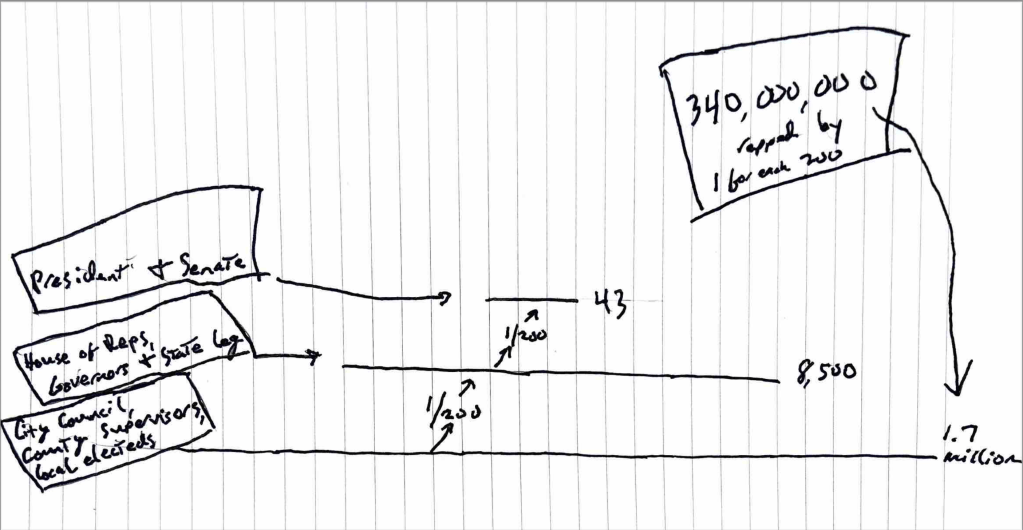
Literally hand drawn. You’re welcome

If Neighborhood Reps connect everyone to their local elected officials, then the next layer up (the 8,500) could connect Americans (via their Neighborhood Reps) to their state officials. Here, I’m thinking the House of Representatives, Governors, and State Legislators.

If one representative is tasked with representing every 200 state-level reps, that gives us 43 at the federal level. I think these 43 would directly represent Americans to the Senate and the President.

How these representatives would interact with our elected lawmakers is difficult to define, but I think we all can see now that our lawmakers simply cannot effectively represent the massive amounts of people that are in their regions. My local county supervisor, the closest elected official that is supposed to represent me, has about 50,000 people in their region. The closest city to me has five city council members for a population of 68,000. That’s one person for every 13,600 people. Do you think you can represent fifty thousand people such that they all feel like their needs are heard and represented? What about thirteen thousand people?

No, I don’t think you can. I don’t think I can. I don’t think anyone can. I think in America we’ve forgotten that the government is us. It isn’t something that is separate from us. It’s not the people versus the government. The people are the government. I think a big reason we’ve forgotten this is that we’re so disconnected from the decision making in our government. I think it’s time to try things to change that.

They Can’t Stop Us From Helping Each Other

It is never too early to start building the community you want to live in.

Recently I’ve seen some folks posting online about how, at this point in Trump’s last presidency, protests were filling the streets. How that isn’t happening this time around, and despair that there isn’t a more concerted effort to resist his destruction of the myriad institutions that make this country what it is.

I get how that can be despairing. Have people given up? Have we been defeated that easily?

I don’t think so. I think, what is apparent to so many of us whether we’ve put words to it or not, is that it is time for a paradigm shift. The way that well meaning people did politics in America doesn’t work, and hasn’t been working for years. I think that we’ve been clinging to old, ineffective strategies and tactics. I think our clinging to them is why Trump got elected the first time in 2016, and why he got re-elected in November.

I also think I know the work that it’s going to take to not only win out in this moment, but to ultimately inoculate America against fascist politics in the future.

But the ideas I have are not easy. A marketing campaign will not work. A pivot will not work. No set of focus groups is going to give us the answers we are looking for. Turning around this ship is going to take years. It’s going to take years because it’s years of work that, I think, a functioning society should have been doing the whole time. But we haven’t been doing it. Not only have we been letting our literal infrastructure decay and rot in this country, but we have been letting our civic infrastructure decay and rot as well. We’re starting at a deficit.

Something we can all do is build community. Find people who are like minded to you, and get to know them. Find the people who are present in your community, and get to know them too. Find the people who are different from you, and get to know them also. Get to know the decision makers, get to know the people who receive the effects of decisions. It is never too early to start building the community you want to live in. Don’t think on a large scale, think on the scale of your neighborhood, your town, your city, your county. It might seem like it will take forever to build community in every town, city and region in the country. Yes, it will, if only a few of us are doing it. But the more you build community with the people around you, the more community will expand through all the networks that naturally connect us. My one caveat here, however, is that we must build community in person. Online is great for marginalized groups. But the groups that feed us, shelter us, care for us, the groups that we work for and with – they can never be marginalized. Other than that I’m not going to tell you how to do it. I think the power actually lies in different people solving this problem in their own way. But I am sure that the more all of us feel connected to the communities around us, the more secure we are going to feel as the news from Washington DC gets scarier – and the better positioned we are going to be to defend ourselves and those we care about from what is to come.

This next idea is specifically for the politically connected: unite the country. I imagine that sounds painfully simple to the point of uselessness. The good things in life generally are simple. Having just read this explanation of how George Soros became a political boogey-man, it became clear that the politics of division were not successful immediately. They were something that was honed, tried, and experimented on over and over again. Folks who sought to divide us tried countless ways to do so, and simply stumbled upon the ways that worked. After trying for decades, of course they have now found a relatively reliable strategy. It is time for us to make that investment in uniting ourselves and inoculating ourselves against this division. We don’t necessarily know what is going to unite the people of our country together, that should not scare us away from taking on the task. Instead, lets us try all the things that we think could work. Let’s see what produces results, and then iterate from that. You might be thinking that we don’t have time for an iterative process… I would say we’re here now because we never took the time for an iterative process. If we don’t take that time, we’re never going to have the country we want.

I do believe that our country will be better at the end of this. If we want to take a long view of the challenges that face us, I would say that we face these challenges because we have not yet figured out how to prevent them. At all times in human history, people have been confronted by things that they could have prevented if they had known different. And people muddled through until they found the answers they needed. We will keep being confronted with this challenge, in different forms, until we learn to prevent it from happening. World War II, as awful as it was, was not enough for us to learn the lessons we needed to keep this from happening again.

I may have an even more positive view than Chris Hayes does, above. I believe that we are very near to being primed to being the awakened giant that Isoroku Yamamoto (probably didn’t so eloquently) claim we were after the bombing of Pearl Harbor. I believe this because, in my years being a human, I have found that we come to be defined by the challenges that we take on. The lessons that we learn from overcoming adversity stick with us well after that adversity is gone, and are passed down over generations. We are about to, finally, take on the challenge of fascist politics in our own country. Something that has existed here since before our founding. An America that knows how to defeat fascist politics when it is in our neighborhoods, in our families, and in our homes… that will be an America that can do great things, again (groan!). That is a future that I want for my country, my community, and my family.

These are my two broad, simple, and challenging goals for the foreseeable future. Build community and unite the country. I invite you to take on these goals as well. Let us see what millions of us can do when we take on this challenge together.

Prop 1

Here are my quick thoughts on California’s Prop 1, since a lot of you are asking. I just read over the description on the primary ballot. I am not a professional legislative analyst, by any means. But I get why you all are here reading this.

-It may end up being a very good thing for residents who suffer from severe mental health challenges. If the state’s estimates are correct, and this bill will provide 6,500 of 10,000 needed mental health beds in the state, then that is a big win.

-The effect that this bill will have on homelessness will be negligible. If the stars align, it will lead to a 2% reduction in homelessness over the next 10 years – with a 20% reduction of veteran homelessness in that time as well. This rosy projection is reliant on buildings getting built and/or acquired somewhere in the state to house people. We all know how challenging that can be.

-It takes some mental health money from the counties and gives it to the state, for some reason. This is perplexing, and pushes me from “it’s flawed but probably still good” to “it may not be worth voting for such a flawed piece of legislation” – knowing that there is not a heck of a lot stopping the state from putting something better on the ballot next election if this one fails. The reality is that money to be spent on mental health services will get taken from each county right away, and then some years later a mental health facility may or may not show up in that county from the money that comes from this bill.

-It’s really malpractice that this bill would be marketed as addressing the homeless issue. The percentage of our homeless population that faces severe mental health challenges is very low (not that we have good numbers), certainly no more than 5%, maybe as low as 1 or 2%. The idea that most of our homeless population is suffering from severe mental health challenges and/or life altering addiction is a long-dead myth at this point. The actual portion of the bill that addresses homelessness is a drop in the bucket. I’m not sure how I’ll vote, since I’m not opposed to voting for flawed legislation that will still do some good, but the stench of the political machinations behind this bill are a turn off for me.