200 Might be a Magic Number for Representation

What’s next for democracy in America? Here’s one idea to improve it.

While we’re all watching democracy in America be stretched and strained these days… I’ve been thinking; What could make our democracy more representative of Americans? What could make it so regular, every day Americans actually feel connected to our government and our country as a whole? What could help us unlock the thousands, possibly millions, of capable and competent leaders in our country – so it doesn’t feel like we’re almost always having to choose between the least worst of two options?

Also, what can I do? What is the difference that I can make, on top of all of the other commitments that I have?

Me, while I’m writing this. Yes, it’s filtered 😛

I think, on top of all I’m doing as a dad with a full time job, I could effectively represent 200 people over the course of two years or so. That with lunch breaks and a few evenings and weekends, I could make sure that 200 people have someone they can go to to represent them in local matters. I can make sure that local elected officials have someone that connects them to their constituents – at least for the 200 people that I represent. Heck, I could probably act as a something of a hub connecting my local community.

I think that it may be time to experiment with Neighborhood Representatives. What if every 200 people in our country had someone who represented them to the rest of our government system? How empowered and emboldened, and connected, would we be? How motivated would you be to vote if at least one person on every ballot was someone that you know?

But wait, there’s more…

There’s something really cool about the number 200. That is, that it scales really beautifully. Say, for instance, that we implement some sort of Neighborhood Rep system and there is a representative for every 200 people. That representative acts as the liaison between every American and their city council member, county supervisor, school board, and maybe even water district.

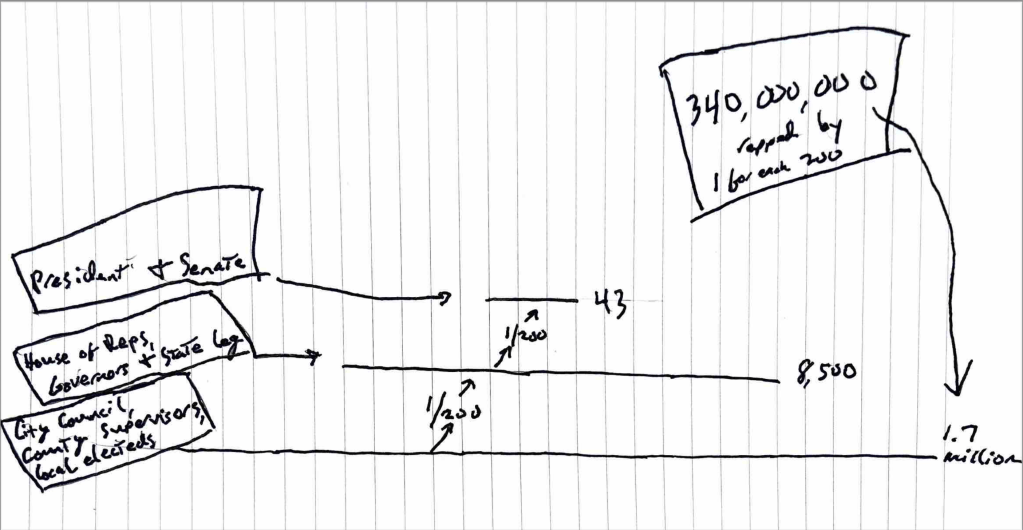
There are 340,000,000 people in the US right now (according to Wikipedia). Divide that by 200, and you get 1,700,000. That’s a heck of a lot of Neighborhood Reps.

But if there’s a rep for every Neighborhood Rep? 1,700,000 divided by 200 is 8,500. 8,500 divided by 200 is 43. This means that, with three layers of representation, we could effectively make sure that every American is represented at the highest levels. That there could be only three degrees of separation between every single American and the highest levels of decision makers in our country.

Here, I hand drew a graphic so you can see what I mean:
Literally hand drawn. You’re welcome

If Neighborhood Reps connect everyone to their local elected officials, then the next layer up (the 8,500) could connect Americans (via their Neighborhood Reps) to their state officials. Here, I’m thinking the House of Representatives, Governors, and State Legislators.

If one representative is tasked with representing every 200 state-level reps, that gives us 43 at the federal level. I think these 43 would directly represent Americans to the Senate and the President.

How these representatives would interact with our elected lawmakers is difficult to define, but I think we all can see now that our lawmakers simply cannot effectively represent the massive amounts of people that are in their regions. My local county supervisor, the closest elected official that is supposed to represent me, has about 50,000 people in their region. The closest city to me has five city council members for a population of 68,000. That’s one person for every 13,600 people. Do you think you can represent fifty thousand people such that they all feel like their needs are heard and represented? What about thirteen thousand people?

No, I don’t think you can. I don’t think I can. I don’t think anyone can. I think in America we’ve forgotten that the government is us. It isn’t something that is separate from us. It’s not the people versus the government. The people are the government. I think a big reason we’ve forgotten this is that we’re so disconnected from the decision making in our government. I think it’s time to try things to change that.
The USA: A Nation at War

We’ve been at war for 206 of our 246 years.

We’ve been at war for 206 of or our 246 years of existence.

If you saw my last post, you know that I started looking at American wars as a way to see how many American Indian tribes we actually went to war with as a country. That led me further, however, to looking at all of our wars. Here is the data that I found, which I’m putting in the sort of overview that was certainly missing from my schooling when I was growing up.

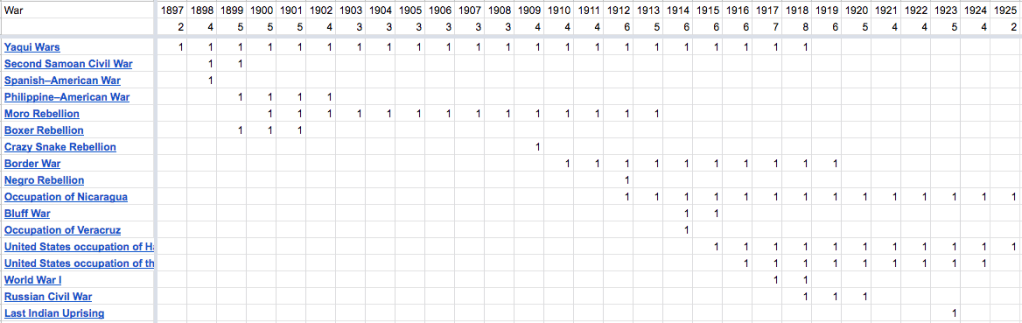
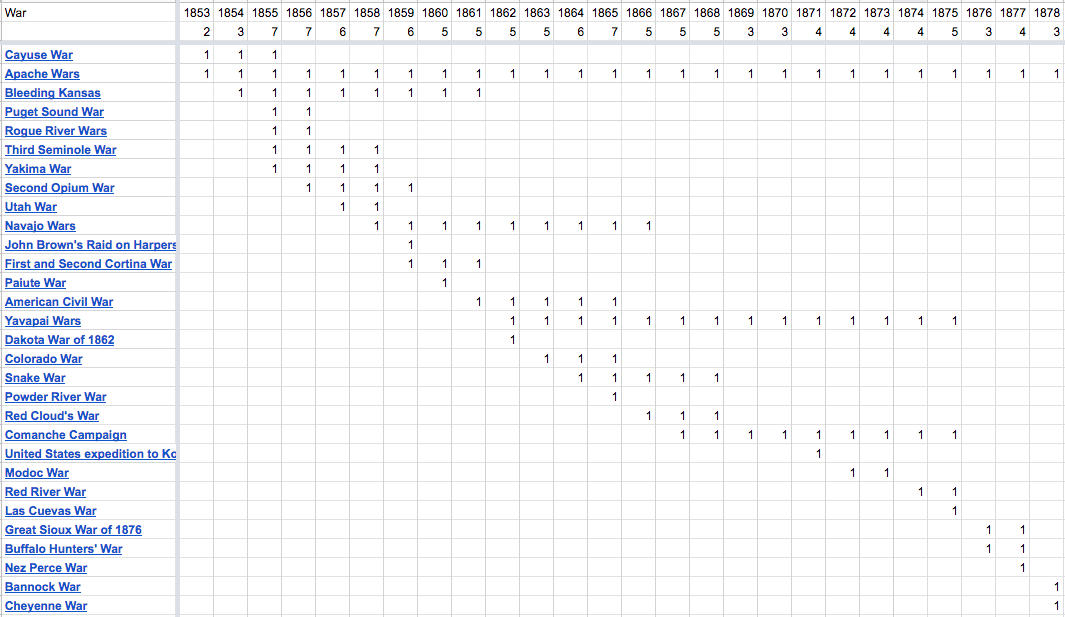
We’ve engaged in 98 different conflicts. That’s one new war every two and a half years. At most, in 1918, we were in engaged in 8 conflicts at once. Many times, we’ve been engaged in seven different wars at once.

1855: Cayuse War, Apache Wars, Bleeding Kansas, Puget Sound War, Rogue River Wars, Third Seminole War, Yakima War

1856: Apache Wars, Bleeding Kansas, Puget Sound War, Rogue River Wars, Third Seminole War, Yakima War, Second Opium War

1858: Apache Wars, Bleeding Kansas, Third Seminole War, Yakima War, Second Opium War, Utah War, Navajo Wars

1865: Apache Wars, Navajo Wars, American Civil War, Yavapai Wars, Colorado War, Snake War, Powder River War

1917: Apache Wars, Yaqui Wars, Border War, Occupation of Nicaragua, United States occupation of Haiti, United States occupation of the Dominican Republic (1916–1924), World War I

1918 (8): Apache Wars, Yaqui Wars, Border War, Occupation of Nicaragua, United States occupation of Haiti, United States occupation of the Dominican Republic (1916–1924), World War I, Russian Civil War

2015: War in Afghanistan, Second U.S. Intervention in the Somali Civil War, Operation Ocean Shield, Operation Observant Compass, American-led intervention in Iraq, American-led intervention in Syria, American intervention in Libya

2016 (same wars as 2015): War in Afghanistan, Second U.S. Intervention in the Somali Civil War, Operation Ocean Shield, Operation Observant Compass, American-led intervention in Iraq, American-led intervention in Syria, American intervention in Libya

I’m taking this list of wars from Wikipedia, so keep in mind it may not be definitive. Some people may want to argue that some of these weren’t “declared” wars, or that they weren’t very “hot” wars, I don’t have any interest in really touching that.

I must confess that I did not even know that we occupied Nicaragua, Haiti and the Dominican Republic at the same time – while we were participating in World War I. The heavy war years of the 1800’s demonstrate how completely we were fighting against American Indian tribes of that time. The Apache Wars went from 1849-1924, though fighting had mostly stopped a few years before 1924. That’s still a 75 year conflict that I knew next to nothing about – that’s 30% of the entire life of America as a country that we were engaged in the Apache Wars. The list above also illustrates how war-heavy our recent years have been, though we often act as if we are not a country at war in modern times. But I suspect, except for the major wars, it has mostly been that way.

A snapshot of the most violent years of the 1800’s in America
The violent years of the early 1900’s
Our most recent era

When was the last year that America did not engage in war? 1985. Our last sustained peace was from 1976-1981. Since it doesn’t make a lot of sense to try to view a spreadsheet like this in PDF format, I’ll give you all this link so you can scroll through if you like.

In terms of amount of wars over a relatively short period of time, 246 years, I don’t know how we compare to other nations of the world. I find it unlikely that I’ll make the time to put together spreadsheets like this for a lot of other countries. Knowing that we have engaged in some sort of war every 2.5 years of our existence is quite informative, in my view. In the 96 years since the final American Indian conflict ended (the final action of the Apache Wars) in 1924, the US has engaged in 31 conflicts. That’s a new conflict every 3.1 years. That’s certainly an improvement over our overall average, but it’s still 3 conflicts each decade. In the 149 years that we were fighting American Indians, we engaged in 69 wars in total. During that time, that was a new war every 2.2 years.

What are my takeaways here? The USA has been at war in one fashion or another for 84% of it’s existence. It’s no wonder that we became active in foreign interventions once the ongoing wars against American Indians came to an end – the public and our institutions were already accustomed to near constant war. That energy needed to go somewhere. This year we have been involved in 4 wars, currently we are still active in 3.

It does seem that it would take a sea change in the way America operates, and the realities of international politics, for America’s thirst for war to go away any time. It may morph, a notable short term improvement in the way our military operates would be to simply stop engaging in conflicts with insurrectionists in foreign countries, but I don’t see our politics changing so dramatically that we are going to significantly increase or decrease the pace at which we engage in war.

Here’s what helped me understand Israel & Palestine

If you’re like me, you learned almost nothing about the ongoing conflict in school

Growing up in the United States in the 80’s and 90’s, everything around me was pro-Israel… without any real explanation of how or why. Nothing truly opened my eyes to the history of the region until I stumbled upon the incredible podcast series by MartyrMade: Fear & Loathing in the New Jerusalem.

Darryl Cooper does a great job of telling the history as well as dispelling many of the myths we’ve been hearing for years.

For those of you unaccustomed to history podcasts, spending hours listening to something like this can seem daunting. MartyrMade is one of the very best out there, and the time goes by fast. History podcasts are my jam, I listen to them while I’m commuting.