200 Might be a Magic Number for Representation

What’s next for democracy in America? Here’s one idea to improve it.

While we’re all watching democracy in America be stretched and strained these days… I’ve been thinking; What could make our democracy more representative of Americans? What could make it so regular, every day Americans actually feel connected to our government and our country as a whole? What could help us unlock the thousands, possibly millions, of capable and competent leaders in our country – so it doesn’t feel like we’re almost always having to choose between the least worst of two options?

Also, what can I do? What is the difference that I can make, on top of all of the other commitments that I have?

Me, while I’m writing this. Yes, it’s filtered 😛

I think, on top of all I’m doing as a dad with a full time job, I could effectively represent 200 people over the course of two years or so. That with lunch breaks and a few evenings and weekends, I could make sure that 200 people have someone they can go to to represent them in local matters. I can make sure that local elected officials have someone that connects them to their constituents – at least for the 200 people that I represent. Heck, I could probably act as a something of a hub connecting my local community.

I think that it may be time to experiment with Neighborhood Representatives. What if every 200 people in our country had someone who represented them to the rest of our government system? How empowered and emboldened, and connected, would we be? How motivated would you be to vote if at least one person on every ballot was someone that you know?

But wait, there’s more…

There’s something really cool about the number 200. That is, that it scales really beautifully. Say, for instance, that we implement some sort of Neighborhood Rep system and there is a representative for every 200 people. That representative acts as the liaison between every American and their city council member, county supervisor, school board, and maybe even water district.

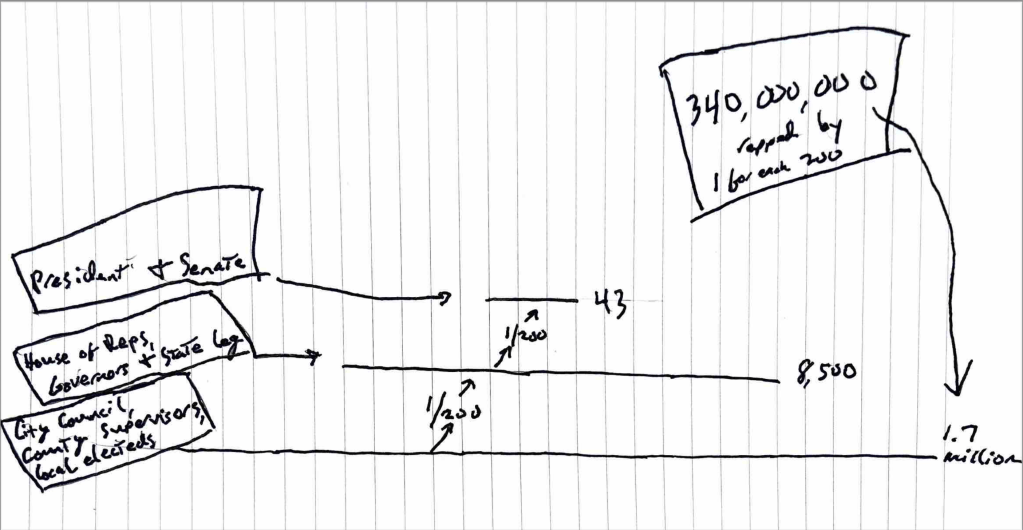
There are 340,000,000 people in the US right now (according to Wikipedia). Divide that by 200, and you get 1,700,000. That’s a heck of a lot of Neighborhood Reps.

But if there’s a rep for every Neighborhood Rep? 1,700,000 divided by 200 is 8,500. 8,500 divided by 200 is 43. This means that, with three layers of representation, we could effectively make sure that every American is represented at the highest levels. That there could be only three degrees of separation between every single American and the highest levels of decision makers in our country.

Here, I hand drew a graphic so you can see what I mean:

Literally hand drawn. You’re welcome

If Neighborhood Reps connect everyone to their local elected officials, then the next layer up (the 8,500) could connect Americans (via their Neighborhood Reps) to their state officials. Here, I’m thinking the House of Representatives, Governors, and State Legislators.

If one representative is tasked with representing every 200 state-level reps, that gives us 43 at the federal level. I think these 43 would directly represent Americans to the Senate and the President.

How these representatives would interact with our elected lawmakers is difficult to define, but I think we all can see now that our lawmakers simply cannot effectively represent the massive amounts of people that are in their regions. My local county supervisor, the closest elected official that is supposed to represent me, has about 50,000 people in their region. The closest city to me has five city council members for a population of 68,000. That’s one person for every 13,600 people. Do you think you can represent fifty thousand people such that they all feel like their needs are heard and represented? What about thirteen thousand people?

No, I don’t think you can. I don’t think I can. I don’t think anyone can. I think in America we’ve forgotten that the government is us. It isn’t something that is separate from us. It’s not the people versus the government. The people are the government. I think a big reason we’ve forgotten this is that we’re so disconnected from the decision making in our government. I think it’s time to try things to change that.

They Can’t Stop Us From Helping Each Other

It is never too early to start building the community you want to live in.

Recently I’ve seen some folks posting online about how, at this point in Trump’s last presidency, protests were filling the streets. How that isn’t happening this time around, and despair that there isn’t a more concerted effort to resist his destruction of the myriad institutions that make this country what it is.

I get how that can be despairing. Have people given up? Have we been defeated that easily?

I don’t think so. I think, what is apparent to so many of us whether we’ve put words to it or not, is that it is time for a paradigm shift. The way that well meaning people did politics in America doesn’t work, and hasn’t been working for years. I think that we’ve been clinging to old, ineffective strategies and tactics. I think our clinging to them is why Trump got elected the first time in 2016, and why he got re-elected in November.

I also think I know the work that it’s going to take to not only win out in this moment, but to ultimately inoculate America against fascist politics in the future.

But the ideas I have are not easy. A marketing campaign will not work. A pivot will not work. No set of focus groups is going to give us the answers we are looking for. Turning around this ship is going to take years. It’s going to take years because it’s years of work that, I think, a functioning society should have been doing the whole time. But we haven’t been doing it. Not only have we been letting our literal infrastructure decay and rot in this country, but we have been letting our civic infrastructure decay and rot as well. We’re starting at a deficit.

Something we can all do is build community. Find people who are like minded to you, and get to know them. Find the people who are present in your community, and get to know them too. Find the people who are different from you, and get to know them also. Get to know the decision makers, get to know the people who receive the effects of decisions. It is never too early to start building the community you want to live in. Don’t think on a large scale, think on the scale of your neighborhood, your town, your city, your county. It might seem like it will take forever to build community in every town, city and region in the country. Yes, it will, if only a few of us are doing it. But the more you build community with the people around you, the more community will expand through all the networks that naturally connect us. My one caveat here, however, is that we must build community in person. Online is great for marginalized groups. But the groups that feed us, shelter us, care for us, the groups that we work for and with – they can never be marginalized. Other than that I’m not going to tell you how to do it. I think the power actually lies in different people solving this problem in their own way. But I am sure that the more all of us feel connected to the communities around us, the more secure we are going to feel as the news from Washington DC gets scarier – and the better positioned we are going to be to defend ourselves and those we care about from what is to come.

This next idea is specifically for the politically connected: unite the country. I imagine that sounds painfully simple to the point of uselessness. The good things in life generally are simple. Having just read this explanation of how George Soros became a political boogey-man, it became clear that the politics of division were not successful immediately. They were something that was honed, tried, and experimented on over and over again. Folks who sought to divide us tried countless ways to do so, and simply stumbled upon the ways that worked. After trying for decades, of course they have now found a relatively reliable strategy. It is time for us to make that investment in uniting ourselves and inoculating ourselves against this division. We don’t necessarily know what is going to unite the people of our country together, that should not scare us away from taking on the task. Instead, lets us try all the things that we think could work. Let’s see what produces results, and then iterate from that. You might be thinking that we don’t have time for an iterative process… I would say we’re here now because we never took the time for an iterative process. If we don’t take that time, we’re never going to have the country we want.

I do believe that our country will be better at the end of this. If we want to take a long view of the challenges that face us, I would say that we face these challenges because we have not yet figured out how to prevent them. At all times in human history, people have been confronted by things that they could have prevented if they had known different. And people muddled through until they found the answers they needed. We will keep being confronted with this challenge, in different forms, until we learn to prevent it from happening. World War II, as awful as it was, was not enough for us to learn the lessons we needed to keep this from happening again.

I may have an even more positive view than Chris Hayes does, above. I believe that we are very near to being primed to being the awakened giant that Isoroku Yamamoto (probably didn’t so eloquently) claim we were after the bombing of Pearl Harbor. I believe this because, in my years being a human, I have found that we come to be defined by the challenges that we take on. The lessons that we learn from overcoming adversity stick with us well after that adversity is gone, and are passed down over generations. We are about to, finally, take on the challenge of fascist politics in our own country. Something that has existed here since before our founding. An America that knows how to defeat fascist politics when it is in our neighborhoods, in our families, and in our homes… that will be an America that can do great things, again (groan!). That is a future that I want for my country, my community, and my family.

These are my two broad, simple, and challenging goals for the foreseeable future. Build community and unite the country. I invite you to take on these goals as well. Let us see what millions of us can do when we take on this challenge together.

The Speech TEDx Rejected

to be fair, it’s not as if they read it…

Hey all, so I was approached a few months ago and asked to apply to speak at the upcoming TEDx in Santa Cruz. This sort of thing isn’t something that is normally on my radar, but because someone I know asked me to apply – I figured it was worth checking out.

In the course of filling out the application, I felt like I had to actually write the speech. The problem is, is once I write a speech I gotta give the speech. This, written for the TEDx audience, is something I really want to give. I recently got the email from them saying that they got SO MANY submissions and decided not to go with mine. But now I’ve written this speech, I can’t just leave it on my hard drive never to be shared.

So I’m putting it here. A couple notes on it: 1) It has not been edited (TEDx points out that there is a comprehensive editing process involved in their speeches, this got none of that) 2) Since this speech wasn’t scheduled to be given until April, I’m referring to the new name of my organization. Watch this space to see more info on our renaming! 3) The TEDx folks didn’t actually read this speech. They had me answer a bunch of questions about it. 4) I feel like I took a couple big swings here, hoping to find out how people would respond. I may never know now. 5) For those of you who read this blog regularly, you’ll certainly recognize some of these themes… hopefully some of this is still new for you.

After all that, here you go:

When I was a boy, I figured that there were two kinds of people; people who made things happen and people who were affected by what happened.

I wanted to be someone who made things happen.

As an adult, my perspective has changed. There are people who are close to our apparatus of power, and there are people who are far away from it. The people who are close to it get to make things happen, and the people who are far away from it do not.

I’m Evan Morrison, Executive Director of People First of Santa Cruz County. We are the newest, nimblest homeless services agency in Santa Cruz County. Our founding members are made up of industry veterans who wanted to have an agency through which we could serve the community as we saw fit. So we started a new one.

Every day I work with the most disadvantaged people in our community. I also work with the most advantaged people in our community in an effort to make a difference with our homeless residents. And I think that our homelessness situation, our crumbling democracy, and our crumbling institutions, are all symptoms of the same disease. I think we have a civic crisis in America.

We are accustomed to our systems not working. We are used to our government not working. We are used to our healthcare providers not working. We are used to our education being broken. We are used to businesses extracting profit from us instead of serving our needs. We are used to seeing homeless people on the street. And yet, we should be used to none of these. We are used to them because we feel powerless in this system.

We feel powerless in this system because we are. We have to spend so much energy psyching ourselves up, thinking “I can make a difference!” “one person can make a change!” “my voice matters!” because the truth is that the system is stacked against each one of us. In order to make a difference, we have to overcome the resistance built into our system.

We need to re-make our democracy if we want our democracy to work. Our democracy was made to serve 2.5 million people. We now have over 330 million. It is absurd to think that any system would scale effectively when stretched to over 100 times it’s original capacity, yet that is exactly what we have done with our most sacred of systems; democracy.

People made this system, and people can change this system.

We’ve spent so much collective energy excoriating our founding fathers, that we’re forgetting that they were regular people who were prone to error – just like we are. And if they could make a democracy that fit their values, then we can make a democracy that fits ours.

If our government doesn’t meet our values, we must change it. If our constitution doesn’t meet our values, we must change it. We say how it goes.

How does this relate to homelessness? I work with people who are homeless every day, and I work with them to make progress in their lives such that they can end their homelessness and be in a good place in life. All of the people I have worked with owe their prolonged homelessness to a failure of our systems. We have remedies in place to address any issue they may have. We have just failed to deploy them effectively.

Humans are a community animal. If someone is suffering in our midst, it reflects on us just as much as it reflects on them.

Homelessness is a crisis. For hundreds and thousands of years, humanity has been responding to crises. We rally together, we deal with the crisis, and then we go back to our regular lives. What is the crisis? People don’t have places to live. So we make or identify homes for them. It’s called homelessness after all, so logically we’d solve this crisis by putting people in homes.

Yet something is stopping us. We don’t have a lack of resources. We don’t have a lack of land. We… have gotten used to our system failing. We have gotten used to thinking of the system as saying no to solutions, and being powerless to change the system.

But the system isn’t just a system. The system is us. All it takes is us coming together, agreeing on solutions, and implementing them. But in every area, on every issue in this country, we are standing apart.

How many of you have a personal relationship with your local elected officials? Of those who don’t, how many of you know someone who does who can help to advocate for you on your behalf? I’m guessing most of the people listening to me now do not. That is not okay. How can we affect a system, any system, without having a relationship with it? How can we affect a system made of people without having a relationship with the people inside of it?

We cannot.

I’m going to make another assertion. That the experience of having no say over systems that don’t serve us, and that are clearly broken – that experience itself causes trauma. It drives us to paranoia. It drives us to conspiracy thinking. It drives us to think that the best thing to do is to burn it all down.

We’ve created beautiful things in this country, but if we don’t modify those things to meet who we are today….

It may very well be burned down.

I feel like I’m supposed to have an uplifting message here. This is a TED talk, after all. I don’t have one yet. I’m so accustomed to working on unsolvable problems, problems that need everyone’s attention yet aren’t getting that attention… that it’s hard for me to imagine an America where folks rally to end this crisis that is happening right before all of our eyes.

But I will say this. That desire I had, when I was a boy, to be someone who made things happen. That cannot be a goal for everyday Americans. It should not, it cannot be something to aspire to – as it was for me. It needs to be a reality we are all born into.

But for that to be a reality, we have to stand up for each of us to be heard. You fighting for your say won’t get us there. Us fighting for all of our say will. Let’s make a promise to each other that we will ensure that each of us has access to power. Let’s commit that we all will share that power, in a way that doesn’t exploit any of us. Let’s promise to work together, and not at odds with each other.

About homelessness, I’ve found myself saying that it’s an all hands on deck situation – but no one knows where the deck is. The obvious solutions seem impossible and the subtle solutions seem invisible. Our homeless family members, friends, neighbors, and community members have been forced to give up everything on the path to becoming homeless. But… are we willing to sacrifice so our neighbors can get back to having good lives, as we do? Are we willing to sacrifice some of our parks or open spaces? Are we willing to sacrifice how we thought our cities should look? Are we willing to sacrifice how we thought our careers, or our lives, would go? Is your career actually fulfilling, anyway? Are we willing to sacrifice our profits, so that our neighbors can have good lives like ours? Are we willing to drop what we are doing and embrace one of our deepest callings as humans… to help other humans in need?

In the all hands on deck metaphor, the deck is our neighborhoods. The deck is our towns, our cities, our communities. If we go outside and talk to people, that is where we need to be.

One thing that makes humans unique in the animal kingdom is our ability to adapt. When we are faced with a challenge, we adapt so we can overcome that challenge. In America, we adapted and overthrew the yoke of monarchy. We adapted, and undid legal slavery. We adapted, and fought to end two world wars. We adapted, and we went to the moon. Each time we adapted, we became stronger and expressed new dimensions of who we are as a country and as a people.

It is now time to adapt to our current crisis. What is clarifying about crises is eventually, the only way to move forward is to throw out some of the old ways of doing things. We have reached that time now with homelessness… and with the state of our country.

I want us, I want America, to be what it’s going to take to end homelessness here. I want us to be stronger not just in fighting wars or accomplishing feats, but in loving each other. In your own communities, in whatever way you can, join me. Let’s end homelessness together.

Well, 2024, We’re Here Whether We Like it or Not

I’m coming into 2024 with a lot on my mind. We recently had to say goodbye to our good friend Joshua Coffy. My father in law passed away this year. Burning Man was a mess…

Professionally, someone recently told me that what my org is doing is “meteoric.” Since being nothing but an idea at this time in 2020, as of Tuesday we have nine full time staff, and handful of part-time staff, a budget over $1 million, and are about to move into our first real office space. Our initial program housed 45% of it’s participants in it’s first 14 months. And, there is so much more coming in 2024. The possibilities and opportunities on the horizon in 2024 are truly mind-boggling to me. I find myself looking into the future, seeing a bunch of question marks, and taking actions today to get answers to those questions. It is a challenge that I find myself relishing – even though it is often stressful.

The next thing for me is really cementing the way that we provide services throughout the organization. One thing, of many, that is going to distinguish us over time is delivering very effective services. To do that, we are going to have to codify what that means internally. I’m excited for that. A cool thing about our organization being about growth, healing and ending homelessness is that the growth and healing happens on our team as well. Yet, if we are about that internally as well as externally, how do we manage the logistics of that? This is a question I’m eager to answer.

Local politics will also determine the trajectory of what my org is doing. There are sales tax measures on both the city and county ballots that may directly fund our programs, if passed. There are also three elections at the county supervisor level that will change what decisions get made in our entire region.

My daughter (facebook link) continues to amaze me in her short time working in acting and modeling.

And yet, all bets are off if Trump wins in November. The relative stability that has marked our country since the Great Depression will be in danger, if not outright gone immediately. Professionally, I sometimes worry that I’m re-arranging deck chairs on a sinking Titanic. No one’s life will improve in the long term if Donald Trump serves another term, and that reality is going to present all of us with challenging decisions to make.

If you read me regularly, you know that Democracy is a prime value to me. I understand and sympathize with folks who feel like our system is broken. I agree that it is broken. But we cannot throw it out to replace it with a dictator. Those of us who criticized him in 2015 turned out to be right – please listen to us now as we continue to criticize him. He will dismantle the very thing that does actually make America great. I’m sure this list is just a start.

Let’s Re-Claim “Woke”

It’s about respect, not about censorship

I’m going to posit a new working definition of the word Woke.

Woke: Respecting the history and life experience of historically marginalized people and treating historically marginalized people with dignity.

Hopefully that’s a pretty straightforward definition for most of you. Because if that definition stands, then the opposite is also true.

Anti-Woke: Disrespecting the history and life experience of historically marginalized people and treating historically marginalized people without dignity.

I think that second definition is more useful. Sure, you can be anti-woke. Sure, you can disrespect marginalized people – but if you are disrespecting marginalized people get the f**k out of the public square and come back when you have calmed down and can behave with dignity and respect again. This doesn’t require the government to step in. It doesn’t require arguments about the first amendment. It requires adults to step in when someone has lost their head and setting them straight. And if you refuse to show marginalized people respect and dignity? Then we all know who you are and what you are about.

But, if you aren’t able to respect or dignify marginalized people… move out of the United States. Because this country is filled with folks who have historically been marginalized, daily life is going to be rough for you. Move away. This country is the land of the free and the home of the brave. If you aren’t brave enough to show people basic respect, you aren’t brave enough to be an American. You are too fragile to be American.

This brings me to a fundamental misunderstanding of humanity in our modern social media platforms. Facebook figured out that posts that elicit anger get more interactions, keeping more people on their platform longer. They didn’t realize that the anger is people’s innate instinct to reign in people who are being assholes. So the more they boosted asshole content, the more people felt the need to reign it in. Why does this matter? Because if you are going to facilitate the public square, you need to actually facilitate it. If someone is showing up and getting everyone to yell at them, it’s time to remove them and take some time to get their head straight. Not encourage their asshole behavior. When you do that, when you let regular people see that no one is going to stop the assholes, then you give the space over to the assholes. Without regulation, bad actors do whatever they want. You have now ceded your public square to the worst of us. Whatever discussions that educate, provoke the intellect, create friendly and loving connections, and stir the soul have now taken a back seat to assholes yelling.

Facebook and Twitter (every other social media platform seems to aspire to be them) have created a public square and signed up to be the facilitators. They seem not to realize, though, that the role of the facilitator is the most important role in the public square. If people can’t trust the facilitator to facilitate fairly and to make sure the public square is a safe place to be, they will leave. Twitter, at this moment, seems to be wrapped up in thinking they have to enforce everyone’s first amendment rights. But Twitter has no obligation to let everyone speak whatever they want on their platform. In fact, the opposite is true. If they allow everyone to say whatever, then the entire place will devolve into bots and assholes yelling at each other. Twitter, if it wants to maintain it’s user base, needs to let it’s users know that they can safely be there. So far, it has failed to do so. The first amendment only applies to the US Government. Twitter is not the government.

If you actually value conversations that help people to change how they view the world, you have to ensure that they are experiencing psychological safety. What is psychological safety?

For those of you who need a url, check out this url: https://www.ccl.org/articles/leading-effectively-articles/what-is-psychological-safety-at-work/

If you are a free speech absolutist, then you aren’t going to stop people from being punished, humiliated, or shouted down for sharing their ideas. Eventually, you are going to cede your entire space to the yellers – because people who want to do other things aren’t going to hang out in your space.

So how do you reign in assholes without making them feel like they are being targeted for their deeply held beliefs? That’s a hard thing to do. It takes a combination of skills and abilities – and even the people who are good at it are continually bumping up against new challenges in that endeavor. But we have no evidence that people who write code for a living are especially skilled in that work.

Of course, all that I’m talking about unfolds over time. We’re seeing the decline of facebook because they have demonstrated their inability to facilitate effectively. Twitter claims that they are doing well… but we’ll see the reality as the months and years play out.

In the meantime, folks, let’s keep showing people dignity and respect.

A Snapshot of American Well-Being

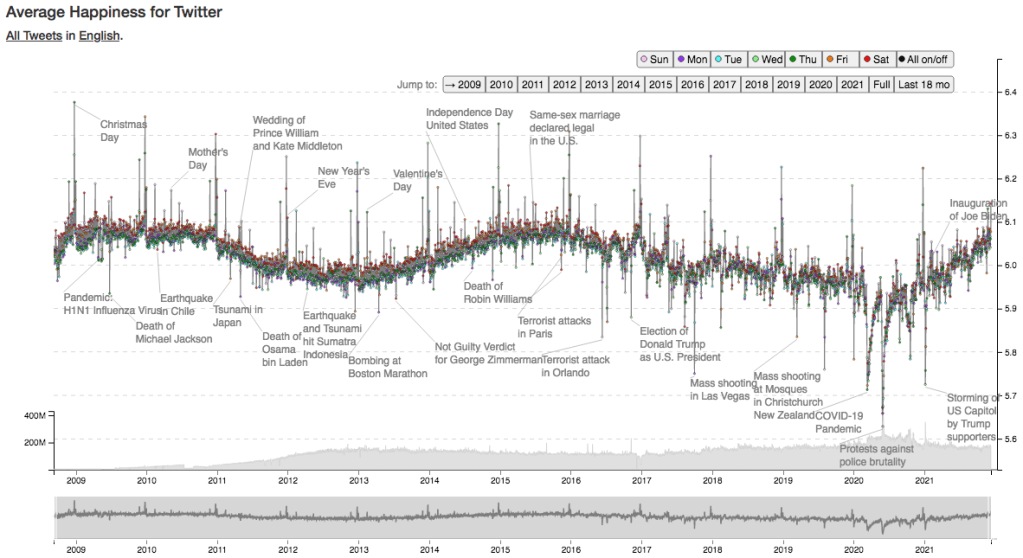
I wish there was a dashboard that we all could look at that would actually tell us where America, or any country for that matter, stood on a variety of indicators at any given moment. That way it would be real easy to actually see how things are going on a large scale in our country. For my viewing pleasure, and I hope yours as well, here is a snapshot of what I would include. I’m not tech savvy enough to figure out how to embed all of these graphs into this page so that they update automatically. If someone out there can tell me how to do that, I’d be very grateful.

Above is the Average Happiness for Twitter, courtesy of hedonometer.org. This graph starts at the very beginning of Twitter, from 2009. Below is the same graph, but for the last 18 months. You can see that the happiness being expressed on twitter has a steady climb upwards in the last 18 months. I like how helpful these folks are, that they have put notable events on the graph as well. It’s also notable that we’re currently getting back up to the happiness levels that we were at pre-Trump.

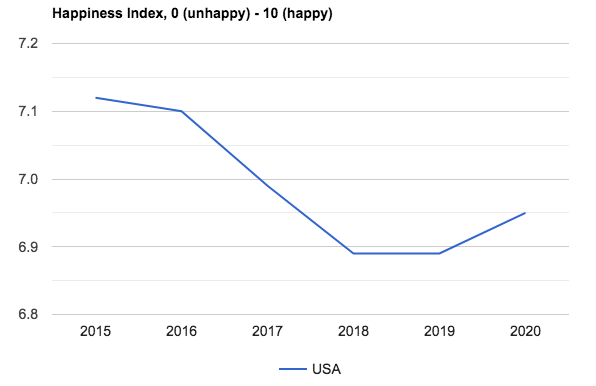
Below is the Happiness Index for the United States. This data came from the World Happiness Report, but was plotted by TheGlobalEconomy.com. Most of the rest of the graphs on this post are going to be from TheGlobalEconomy.com, so I’ll only put the source if the graph isn’t from there.

Not the sexiest looking graph in the world, but we don’t make graphs to score sexy points! I should point out, that this is the page I’m using at TheGlobalEconomy.com to make these fine graphs.

Next is GDP per capita. That little dip at the end there is the dip from 2019 to 2020.

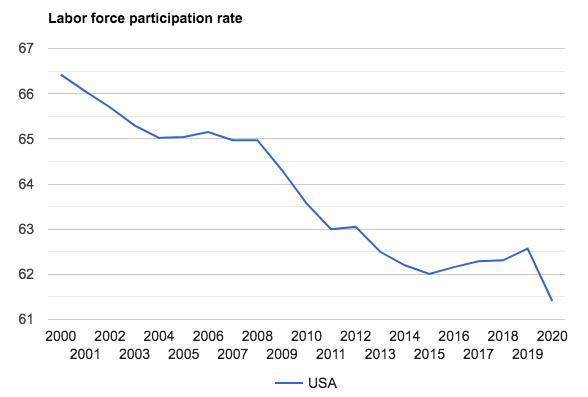
Next is the Labor Force Participation Rate. I haven’t read a lot about why this could be happening, I’d love to see some explanations. Here is a definition of Labor Force Participation Rate, from bls.gov “The labor force participation rate is the percentage of the civilian noninstitutional population 16 years and older that is working or actively looking for work. It is an important labor market measure because it represents the relative amount of labor resources available for the production of goods and services.”

For added context, I’m going to go back to the very beginning of this statistic being tracked on TheGlobalEconomy.com – 1990. You’ll see in 1990 that we had not hit the highest known peak yet, which we reached in 2000. We’ve been on our way down ever since.

Now to the unemployment rate, which is drastically different. This chart came directly from Google. According to the Connecticut Department of Labor, “In simple terms, the unemployment rate for any area is the number of area residents without a job and looking for work divided by the total number of area residents in the labor force.” It’s very interesting to me that the Labor Force Participation rate has been on such a steady decline since 2000, while the unemployment rate has fluctuated so drastically in the last 20 years. Could that be explained by the mass retirement of the baby boomer generation?

Here’s one that I would think would validate the experience of most Americans. The Government Effectiveness Index from the World Bank. Here is there definition: The index of Government Effectiveness captures perceptions of the quality of public services, the quality of the civil service and the degree of its independence from political pressures, the quality of policy formulation and implementation, and the credibility of the government’s commitment to such policies.

The Control of Corruption Index, again from the World Bank. Definition: The index for Control of Corruption captures perceptions of the extent to which public power is exercised for private gain, including both petty and grand forms of corruption, as well as capture of the state by elites and private interests.

The Voice and Accountability Index is also a notable one, again from the World Bank. Definition: The index for Voice and Accountability captures perceptions of the extent to which the citizens are able to participate in selecting their government, as well as freedom of expression, freedom of association, and a free media.

I was wondering why the downward trends on the last three graphs all seemed to start in 2004-2005, then I saw this graph. It’s the Political Stability Index from the World Bank. What the heck was going on in 2004? I don’t remember things being so crazy here then. Definition: The index of Political Stability and Absence of Violence/Terrorism measures perceptions of the likelihood that the government will be destabilized or overthrown by unconstitutional or violent means, including politically-motivated violence and terrorism. The index is an average of several other indexes from the Economist Intelligence Unit, the World Economic Forum, and the Political Risk Services, among others.

Below is the Maternal mortality rate, from UNICEF. I don’t know why we don’t have data after 2017. You can see that 2018 had a rate of 17.4 and 2019 had a rate 0f 20.1 if you go to the CDC. The rates for those years for Non-Hispanic Black people are eye popping. Like double.

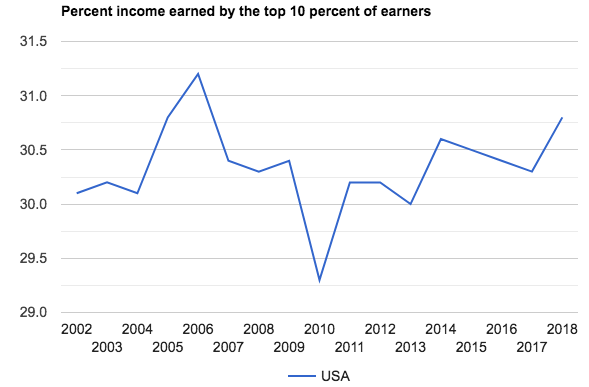
Interestingly, the Percent Income Earned by the Top 10 Percent of Earners – published by the World Bank, does not seem crazy. Or maybe it is, and I’m just used to it?

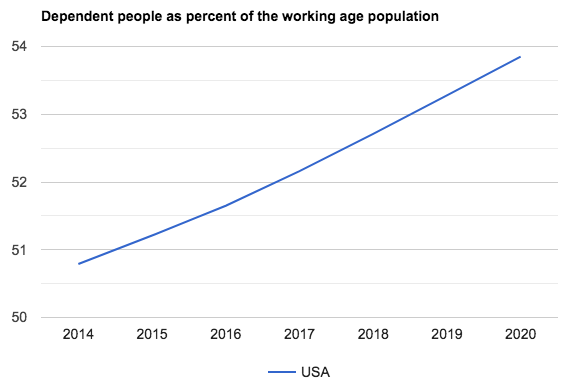
The World Bank also has Dependent People as Percent of the Working Age Population. So all of us who are working have more dependents, apparently. Definition: Age dependency ratio is the ratio of dependents–people younger than 15 or older than 64–to the working-age population–those ages 15-64. Data are shown as the proportion of dependents per 100 working-age population.

Life Expectancy will be interesting to look at once the COVID years are included.

Here’s the birth rate, births per 1000 people.

Here’s the Suicide Mortality Rate, from the World Health Organization.

Hospital Beds have been in a steady decline, per OECD. Why we don’t have data after 2017 is curious, however.

Finally, a graph that isn’t going the wrong direction! Below is Doctors per 1000 people from OECD.

Funny enough, when it comes to crime we start to get data that looks good. First is the Robbery Rate. This is from Statista.

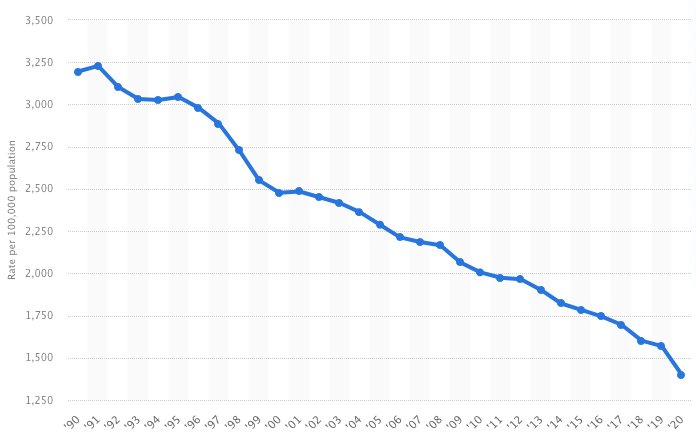
Apparently our imprisonment rate is going down… Though I have seen other sources that have the same overall curve but with higher numbers.

As is our theft rate. This is from Statista as well.

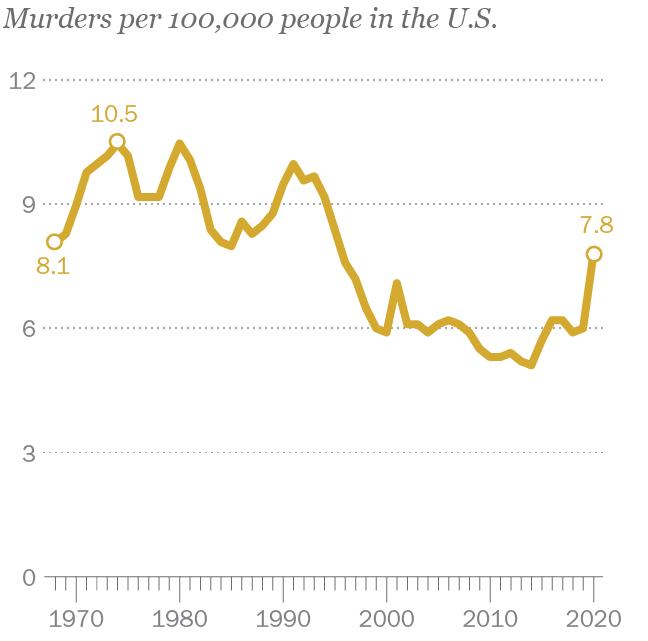
Our homicide rate is interesting. It looks like it started to go up in 2015 or so. This graph is from Pew. Interestingly, 2015-2016 is when our indicators for happiness at the top of this page started to go down. Pew wants us to note that the 2020 data is provisional, and that the data came from the CDC.

This is the estimated homelessness rate, I found it on Statista as well. Though it looks like it originally came from HUD. As someone who works with people who are homeless, I should tell you that these numbers are rough estimates at best.

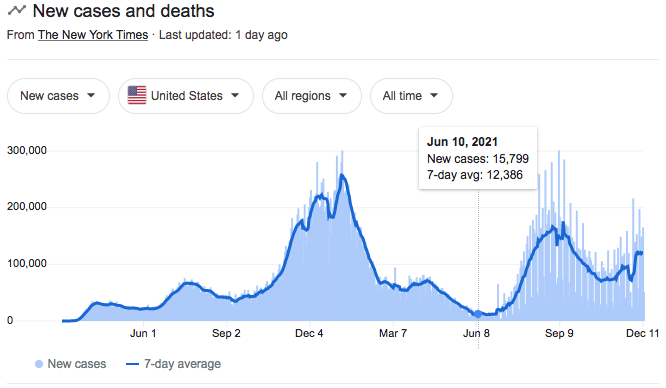
Finally, how’s COVID going? Here is the chart Google provides.

What are my takeaways from all of this data? I’ll break it down.

What’s trending poorly?
-Happiness, but it is beginning to rebound
-Labor Force Participation Rate
-Government Effectiveness
-Control of Corruption
-Voice and Accountability
-Political Stability
-Maternal Mortality
-Our amount of dependents
-Birth Rate (or is this bad?)
-Suicide Rate
-Hospital Beds
-Homicide Rate
-COVID (we’re now in a true second wave)

What’s steady?
-Unemployment
-Percent of Income Earned by Top 10 Percent of Earners
-Homelessness

What’s trending well?
-GDP
-Life Expectancy
-Doctor Rate
-Robbery Rate
-Prisoner Rate
-Theft Rate

Overall, not good. One’s ability to be employed and avoid being the victim of property crime is trending well. But all of the indicators that are about quality of life look bad, and most of them have looked bad for a while. It’s no wonder that over the last few years some people have said that America is in decline. In some notable ways, it is. I’m tempted to link the sudden spike in our murder rate to a general feeling in our culture that there is a lack of trust and support – as illustrated by the other poorly trending indicators I have here… but that truly is just an opinion. I lean that way because there has been no corresponding spike in property crime – so the desperation that we think leads to property crime doesn’t seem to carry over to homicide.

I’m going to leave this here, all under the American Well Being category on this site. I expect I’ll only do updates once a year or so to this category, but it should continue to be easy to find when you come to my website. A big part of why I wanted to make this is so I could reference it when I need it – now it is here for you too.

Here’s some stuff for me to reference for the next blog I do on this topic: https://www.countyhealthrankings.org/health-data

https://www.healthyplacesindex.org/

https://www.opportunityatlas.org/

The USA: A Nation at War

We’ve been at war for 206 of our 246 years.

We’ve been at war for 206 of or our 246 years of existence.

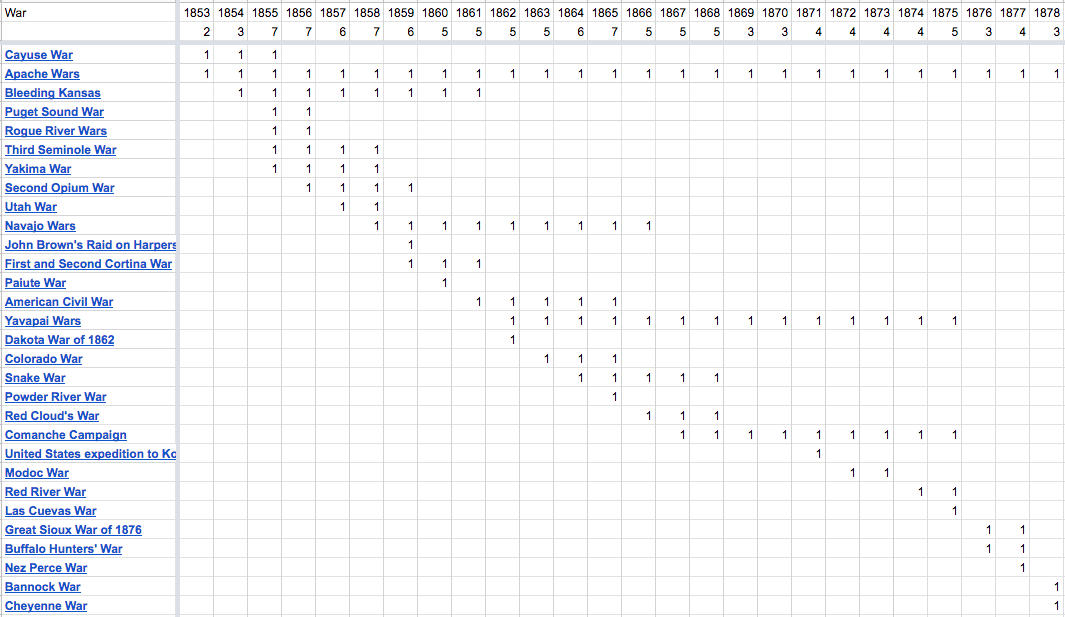
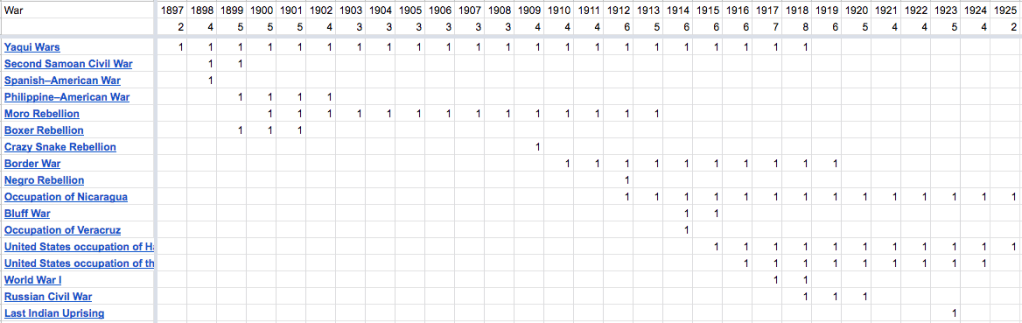
If you saw my last post, you know that I started looking at American wars as a way to see how many American Indian tribes we actually went to war with as a country. That led me further, however, to looking at all of our wars. Here is the data that I found, which I’m putting in the sort of overview that was certainly missing from my schooling when I was growing up.

We’ve engaged in 98 different conflicts. That’s one new war every two and a half years. At most, in 1918, we were in engaged in 8 conflicts at once. Many times, we’ve been engaged in seven different wars at once.

1855: Cayuse War, Apache Wars, Bleeding Kansas, Puget Sound War, Rogue River Wars, Third Seminole War, Yakima War

1856: Apache Wars, Bleeding Kansas, Puget Sound War, Rogue River Wars, Third Seminole War, Yakima War, Second Opium War

1858: Apache Wars, Bleeding Kansas, Third Seminole War, Yakima War, Second Opium War, Utah War, Navajo Wars

1865: Apache Wars, Navajo Wars, American Civil War, Yavapai Wars, Colorado War, Snake War, Powder River War

1917: Apache Wars, Yaqui Wars, Border War, Occupation of Nicaragua, United States occupation of Haiti, United States occupation of the Dominican Republic (1916–1924), World War I

1918 (8): Apache Wars, Yaqui Wars, Border War, Occupation of Nicaragua, United States occupation of Haiti, United States occupation of the Dominican Republic (1916–1924), World War I, Russian Civil War

2015: War in Afghanistan, Second U.S. Intervention in the Somali Civil War, Operation Ocean Shield, Operation Observant Compass, American-led intervention in Iraq, American-led intervention in Syria, American intervention in Libya

2016 (same wars as 2015): War in Afghanistan, Second U.S. Intervention in the Somali Civil War, Operation Ocean Shield, Operation Observant Compass, American-led intervention in Iraq, American-led intervention in Syria, American intervention in Libya

I’m taking this list of wars from Wikipedia, so keep in mind it may not be definitive. Some people may want to argue that some of these weren’t “declared” wars, or that they weren’t very “hot” wars, I don’t have any interest in really touching that.

I must confess that I did not even know that we occupied Nicaragua, Haiti and the Dominican Republic at the same time – while we were participating in World War I. The heavy war years of the 1800’s demonstrate how completely we were fighting against American Indian tribes of that time. The Apache Wars went from 1849-1924, though fighting had mostly stopped a few years before 1924. That’s still a 75 year conflict that I knew next to nothing about – that’s 30% of the entire life of America as a country that we were engaged in the Apache Wars. The list above also illustrates how war-heavy our recent years have been, though we often act as if we are not a country at war in modern times. But I suspect, except for the major wars, it has mostly been that way.

A snapshot of the most violent years of the 1800’s in America
The violent years of the early 1900’s
Our most recent era

When was the last year that America did not engage in war? 1985. Our last sustained peace was from 1976-1981. Since it doesn’t make a lot of sense to try to view a spreadsheet like this in PDF format, I’ll give you all this link so you can scroll through if you like.

In terms of amount of wars over a relatively short period of time, 246 years, I don’t know how we compare to other nations of the world. I find it unlikely that I’ll make the time to put together spreadsheets like this for a lot of other countries. Knowing that we have engaged in some sort of war every 2.5 years of our existence is quite informative, in my view. In the 96 years since the final American Indian conflict ended (the final action of the Apache Wars) in 1924, the US has engaged in 31 conflicts. That’s a new conflict every 3.1 years. That’s certainly an improvement over our overall average, but it’s still 3 conflicts each decade. In the 149 years that we were fighting American Indians, we engaged in 69 wars in total. During that time, that was a new war every 2.2 years.

What are my takeaways here? The USA has been at war in one fashion or another for 84% of it’s existence. It’s no wonder that we became active in foreign interventions once the ongoing wars against American Indians came to an end – the public and our institutions were already accustomed to near constant war. That energy needed to go somewhere. This year we have been involved in 4 wars, currently we are still active in 3.

It does seem that it would take a sea change in the way America operates, and the realities of international politics, for America’s thirst for war to go away any time. It may morph, a notable short term improvement in the way our military operates would be to simply stop engaging in conflicts with insurrectionists in foreign countries, but I don’t see our politics changing so dramatically that we are going to significantly increase or decrease the pace at which we engage in war.

For Indigenous People’s Day, I Made A Spreadsheet

You know if I care enough to make a spreadsheet about it, I really care

Something I heard a while ago has stuck with me. I don’t remember the exact wording of what the person said, at all, but it was something like this: “Of course there was vibrant, established civilization in the Americas before white people showed up.” Like, the land here wasn’t free for the taking. It was conquered, nations were destroyed, people were displaced.

Growing up where and when I did, this reality was downplayed when I was taught history. People who subjugated Native Americans weren’t outright celebrated for the subjugation, but they were often excused or celebrated for other reasons. I remember my high school history teacher excusing Andrew Jackson‘s exploits before and during his presidency by saying that the American people would inevitably have pushed the Seminole out of Florida, he just tried to do it as humanely as possible. Of course, Columbus Day was still a thing when I was growing up as well. I guess it still is.

Anyway, I’ve been reading this book

Excuse my phrasing here, but reading about Indian war after Indian war after Indian war after Indian war just got to be so much. Like, how much did we do this?

So I went and looked at the list of American wars on Wikipedia. Somehow it never sank in for me the true extent of how much war our country engaged in with Native Americans.

Here’s an image of my first version of the spreadsheet

On the left, each tribe that was involved in an American war. That’s 70 tribes. Some tribes were allied with the US for some wars. Most weren’t. Some were allies sometimes, enemies others. I haven’t, and will not for this post, gone into depth on all the wars that the US engaged in with Native American tribes. What struck me is the sheer volume. The nonstop war. From the moment the USA first started to exist (which I’m marking at the beginning of the Revolutionary War) until 1924 – a 149 year span – I only counted 32 years where we weren’t engaged in some sort of military action against Native American tribes. That’s over one hundred years of conflict. There were times, especially in the 1850’s and 1860’s, where the US was fighting five or six conflicts against natives at once. I counted eight conflicts, some years-long, that took place during the Civil War. Our Civil War cost us hundreds of thousands of lives, yet we had the bandwidth to fight eight other conflicts with Native Americans?

I counted 69 wars that America engaged in between 1775 and 1924. 42 were exclusively against native tribes. That’s 61%. Also… with all the wars put together that’s a new war every 2.2 years. That’s a lot of war. Take out the wars against Native Americans, and we still engaged in a war every 5.5 years. That seems like a lot. But this stuff is for my next post, not this one…

We went to war with some tribes so many times. The Cheyenne? Seven times. Arapaho? Six times. Paiute? Five times. Comanche? Four times. Seminole? Four times (The Seminole apparently fought us in a First Seminole War, a Second Seminole War, and a Third Seminole War). Shoshone? Four times. Sioux? Six times.

The drip, drip, drip of war against many of these tribes was something I didn’t understand before. If we couldn’t or didn’t get a tribe to do what we wanted the first time we’d just keep coming back over and over again. No peace was a final peace, it seems, until finally the Native Americans took whatever we were willing to give them. It seemed that as soon as we were done with one tribe, or one area, we would go on to another tribe and go to war against them until we ground them down too. Until we ground them all down.

Here’s the PDF of my spreadsheet, if you’d like to browse it. I was only able to put one link in each cell, so if you want to read about a war that isn’t linked just look amongst the other tribes to find a link to the war.

Of course there was a vibrant civilization here, it was nearly 150 years after the start of our country before it was finally beaten. Before that, more than 150 years as well.

All this data is off of Wikipedia, so it is should all be considered approximate. However, I think the greater point still stands…

Here’s what helped me understand Israel & Palestine

If you’re like me, you learned almost nothing about the ongoing conflict in school

Growing up in the United States in the 80’s and 90’s, everything around me was pro-Israel… without any real explanation of how or why. Nothing truly opened my eyes to the history of the region until I stumbled upon the incredible podcast series by MartyrMade: Fear & Loathing in the New Jerusalem.

Darryl Cooper does a great job of telling the history as well as dispelling many of the myths we’ve been hearing for years.

For those of you unaccustomed to history podcasts, spending hours listening to something like this can seem daunting. MartyrMade is one of the very best out there, and the time goes by fast. History podcasts are my jam, I listen to them while I’m commuting.

Dude, You’re In A Cult

I was scrolling through my twitter feed, as one does, and I saw someone had tweeted something to the effect of “Check in on your MAGA friends. See how they are doing. Do they have any big plans coming up?” I kept scrolling, but that idea stuck with me. So I started checking on my MAGA friends by looking at their facebook feeds.

It’s not pretty, y’all. I saw a lot of denialism. The bubble has not burst. In the past, I have engaged with folks on an argument by argument basis. Like “hey, you know that’s not quite true? Check out this data (citing a source) and this data (citing another source).” Only to be told that my sources aren’t true, and that I’m being lied to. But when I asked them for their sources, I would get nothing whatsoever. Or I’d be told to watch some youtube videos (ha!). Or I’d be told to google something, I’d google it out of due diligence, and find myself in a conspiracy theory and clickbait filled website that clearly has no journalistic integrity whatsoever. Engaging with folks about this stuff became Sisyphean. Yet they are still out there, doing their thing…

Now, I feel like we need to be talking on a different level than individual arguments. I just want to say “Dude, you’re in a cult.”

Always good to keep this handy

I don’t expect that simply pointing out to someone on their facebook page that they are in a cult is going to go well. I don’t expect that pointing out to them that their distrust of “mainstream media” has been weaponized to get them to willingly believe lie after lie after lie… will be accepted readily.

Don’t know the source of this…

But, what is going to make a difference? Back when I was in high school, we’re talking the late 90’s, I would just say the shit I had to say. I would just stir the pot. Some of the desire to do that is still in me. One of my favorite phrases is “the truth shall set you free, but first it shall piss you off.”

I do know from experience, that even if the truth is said in the most caustic way, if it’s repeated and inescapable it will eventually sink in. But how to do that online, during a pandemic, when this sort of communication is effective in person? How do we compete with the lies that are repeated and inescapable to our friends and family who have sipped the kool-aid?

In person, a person can see that when I’m telling them that they’re in a cult that I still love and respect and admire them. Online, I’m just words on a page. A person can think “do you think I’m so stupid that I would join a cult?!?” And I, not seeing that on their face, can’t say “no, being in a cult isn’t about intelligence. It’s about the cult meeting a deep unmet need that you have.” I imagine the person that is being told they are in a cult will think they need to defend themselves, lest they get cancelled, or defend their cult – because cults are bad m’kay. But I don’t want to make their life harder by telling them they are in a cult, I want to make their life easier. I want them to know that the world outside of their cult isn’t filled with scary, lying, evil people. It isn’t filled with communists. It isn’t even filled by deluded sheep that have had their minds numbed by the mainstream media. Really!

I haven’t written something like this before because I have been afraid of the backlash. People in cults don’t like being told they are in cults. Some of those people are my friends. Also, now that the events of the last few weeks have confirmed all of our instincts about Donald Trump as a president, it’s intellectually easier to call a spade a spade. Or a cult, a cult.

I’m not an expert here. I have read quite a bit about cults, and my biggest takeaway has been that no one is really an expert. We might just have to muddle through these conversations.

So, if you think this may apply to you, imagine when I say “Dude, you’re in a cult” that I say it with love. That I’m not attacking you, I’m inviting you to look at life differently. And if you aren’t ready to look at life differently, I’ll be here when you are.