Hey all, so I was approached a few months ago and asked to apply to speak at the upcoming TEDx in Santa Cruz. This sort of thing isn’t something that is normally on my radar, but because someone I know asked me to apply – I figured it was worth checking out.
In the course of filling out the application, I felt like I had to actually write the speech. The problem is, is once I write a speech I gotta give the speech. This, written for the TEDx audience, is something I really want to give. I recently got the email from them saying that they got SO MANY submissions and decided not to go with mine. But now I’ve written this speech, I can’t just leave it on my hard drive never to be shared.
So I’m putting it here. A couple notes on it: 1) It has not been edited (TEDx points out that there is a comprehensive editing process involved in their speeches, this got none of that) 2) Since this speech wasn’t scheduled to be given until April, I’m referring to the new name of my organization. Watch this space to see more info on our renaming! 3) The TEDx folks didn’t actually read this speech. They had me answer a bunch of questions about it. 4) I feel like I took a couple big swings here, hoping to find out how people would respond. I may never know now. 5) For those of you who read this blog regularly, you’ll certainly recognize some of these themes… hopefully some of this is still new for you.
After all that, here you go:
When I was a boy, I figured that there were two kinds of people; people who made things happen and people who were affected by what happened.
I wanted to be someone who made things happen.
As an adult, my perspective has changed. There are people who are close to our apparatus of power, and there are people who are far away from it. The people who are close to it get to make things happen, and the people who are far away from it do not.
I’m Evan Morrison, Executive Director of People First of Santa Cruz County. We are the newest, nimblest homeless services agency in Santa Cruz County. Our founding members are made up of industry veterans who wanted to have an agency through which we could serve the community as we saw fit. So we started a new one.
Every day I work with the most disadvantaged people in our community. I also work with the most advantaged people in our community in an effort to make a difference with our homeless residents. And I think that our homelessness situation, our crumbling democracy, and our crumbling institutions, are all symptoms of the same disease. I think we have a civic crisis in America.
We are accustomed to our systems not working. We are used to our government not working. We are used to our healthcare providers not working. We are used to our education being broken. We are used to businesses extracting profit from us instead of serving our needs. We are used to seeing homeless people on the street. And yet, we should be used to none of these. We are used to them because we feel powerless in this system.
We feel powerless in this system because we are. We have to spend so much energy psyching ourselves up, thinking “I can make a difference!” “one person can make a change!” “my voice matters!” because the truth is that the system is stacked against each one of us. In order to make a difference, we have to overcome the resistance built into our system.
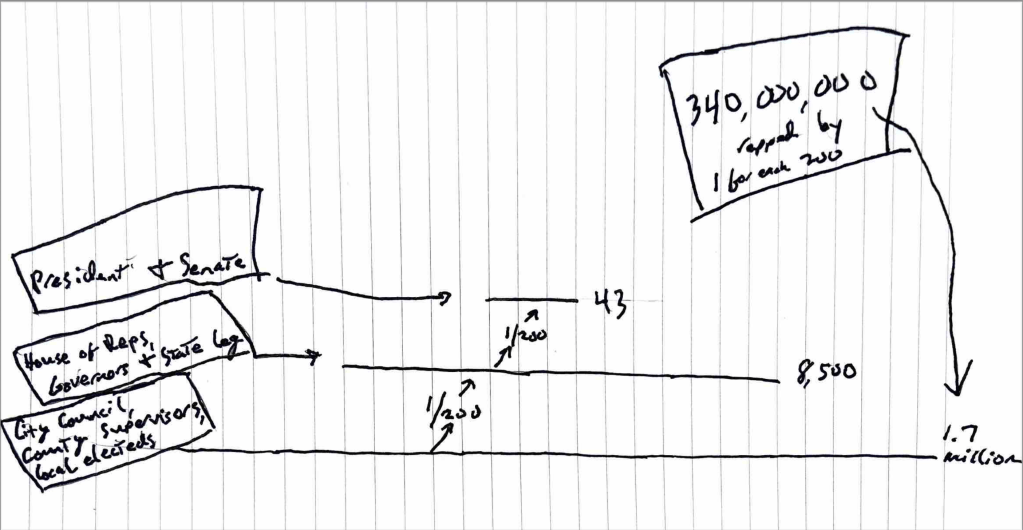
We need to re-make our democracy if we want our democracy to work. Our democracy was made to serve 2.5 million people. We now have over 330 million. It is absurd to think that any system would scale effectively when stretched to over 100 times it’s original capacity, yet that is exactly what we have done with our most sacred of systems; democracy.
People made this system, and people can change this system.
We’ve spent so much collective energy excoriating our founding fathers, that we’re forgetting that they were regular people who were prone to error – just like we are. And if they could make a democracy that fit their values, then we can make a democracy that fits ours.
If our government doesn’t meet our values, we must change it. If our constitution doesn’t meet our values, we must change it. We say how it goes.
How does this relate to homelessness? I work with people who are homeless every day, and I work with them to make progress in their lives such that they can end their homelessness and be in a good place in life. All of the people I have worked with owe their prolonged homelessness to a failure of our systems. We have remedies in place to address any issue they may have. We have just failed to deploy them effectively.
Humans are a community animal. If someone is suffering in our midst, it reflects on us just as much as it reflects on them.
Homelessness is a crisis. For hundreds and thousands of years, humanity has been responding to crises. We rally together, we deal with the crisis, and then we go back to our regular lives. What is the crisis? People don’t have places to live. So we make or identify homes for them. It’s called homelessness after all, so logically we’d solve this crisis by putting people in homes.
Yet something is stopping us. We don’t have a lack of resources. We don’t have a lack of land. We… have gotten used to our system failing. We have gotten used to thinking of the system as saying no to solutions, and being powerless to change the system.
But the system isn’t just a system. The system is us. All it takes is us coming together, agreeing on solutions, and implementing them. But in every area, on every issue in this country, we are standing apart.
How many of you have a personal relationship with your local elected officials? Of those who don’t, how many of you know someone who does who can help to advocate for you on your behalf? I’m guessing most of the people listening to me now do not. That is not okay. How can we affect a system, any system, without having a relationship with it? How can we affect a system made of people without having a relationship with the people inside of it?
We cannot.
I’m going to make another assertion. That the experience of having no say over systems that don’t serve us, and that are clearly broken – that experience itself causes trauma. It drives us to paranoia. It drives us to conspiracy thinking. It drives us to think that the best thing to do is to burn it all down.
We’ve created beautiful things in this country, but if we don’t modify those things to meet who we are today….
It may very well be burned down.
I feel like I’m supposed to have an uplifting message here. This is a TED talk, after all. I don’t have one yet. I’m so accustomed to working on unsolvable problems, problems that need everyone’s attention yet aren’t getting that attention… that it’s hard for me to imagine an America where folks rally to end this crisis that is happening right before all of our eyes.
But I will say this. That desire I had, when I was a boy, to be someone who made things happen. That cannot be a goal for everyday Americans. It should not, it cannot be something to aspire to – as it was for me. It needs to be a reality we are all born into.
But for that to be a reality, we have to stand up for each of us to be heard. You fighting for your say won’t get us there. Us fighting for all of our say will. Let’s make a promise to each other that we will ensure that each of us has access to power. Let’s commit that we all will share that power, in a way that doesn’t exploit any of us. Let’s promise to work together, and not at odds with each other.
About homelessness, I’ve found myself saying that it’s an all hands on deck situation – but no one knows where the deck is. The obvious solutions seem impossible and the subtle solutions seem invisible. Our homeless family members, friends, neighbors, and community members have been forced to give up everything on the path to becoming homeless. But… are we willing to sacrifice so our neighbors can get back to having good lives, as we do? Are we willing to sacrifice some of our parks or open spaces? Are we willing to sacrifice how we thought our cities should look? Are we willing to sacrifice how we thought our careers, or our lives, would go? Is your career actually fulfilling, anyway? Are we willing to sacrifice our profits, so that our neighbors can have good lives like ours? Are we willing to drop what we are doing and embrace one of our deepest callings as humans… to help other humans in need?
In the all hands on deck metaphor, the deck is our neighborhoods. The deck is our towns, our cities, our communities. If we go outside and talk to people, that is where we need to be.
One thing that makes humans unique in the animal kingdom is our ability to adapt. When we are faced with a challenge, we adapt so we can overcome that challenge. In America, we adapted and overthrew the yoke of monarchy. We adapted, and undid legal slavery. We adapted, and fought to end two world wars. We adapted, and we went to the moon. Each time we adapted, we became stronger and expressed new dimensions of who we are as a country and as a people.
It is now time to adapt to our current crisis. What is clarifying about crises is eventually, the only way to move forward is to throw out some of the old ways of doing things. We have reached that time now with homelessness… and with the state of our country.
I want us, I want America, to be what it’s going to take to end homelessness here. I want us to be stronger not just in fighting wars or accomplishing feats, but in loving each other. In your own communities, in whatever way you can, join me. Let’s end homelessness together.

 Evan Morrison's Blog